
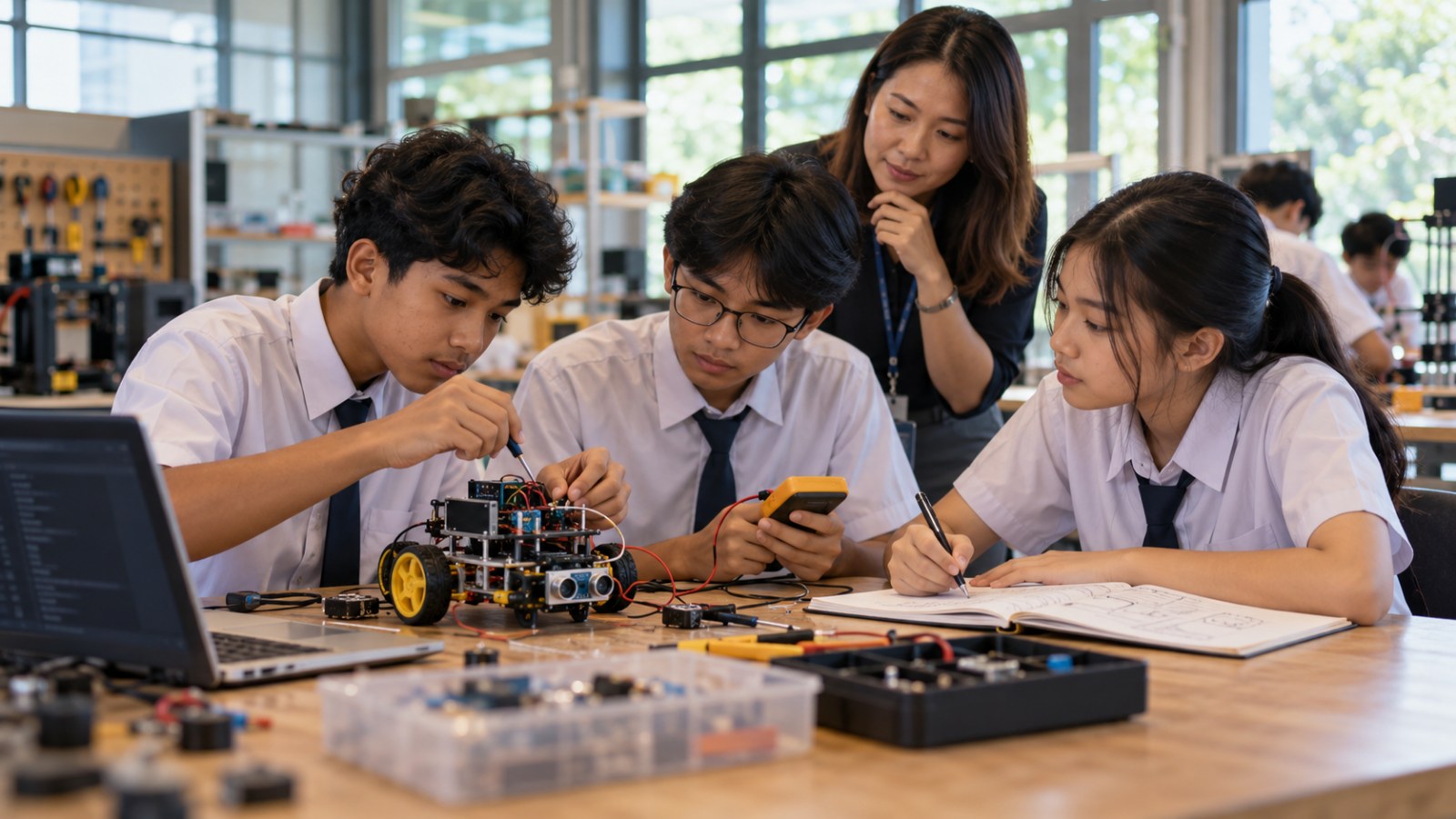
The robot rolls forward, follows the black line around the curve and stops neatly at the finish. Parents applaud, and someone posts a video. Then a visitor asks one of the students a simple question: why does the robot turn left when the sensor sees a dark surface? The student hesitates, looks at the instruction booklet and says that is just how the code was given.
Scenes like this play out in schools across Asia every term. Robotics kits, coding clubs, drone workshops and maker spaces have become standard features of school prospectuses. Many of these programmes do valuable work. But a working robot is evidence that the kit works. It is not, by itself, evidence that students have learned to think like engineers.
For school leaders, STEM coordinators and parents, the useful question is not whether a school “does STEM”. It is whether students can explain, fix, adapt and reuse what they build.
Why This Question Matters Now
STEM education in Asia carries real policy weight. Malaysia has long pursued a 60:40 target for science and technical streams against arts streams. Education Ministry figures reported in 2024 put STEM stream enrolment at around 46 per cent for 2023, and Budget 2024 set aside RM100 million to draw more students into STEM. Researchers in Malaysia have also warned that loose measurement in schools can produce misleading data about STEM participation.
Singapore takes a different route. Its Applied Learning Programme, which many secondary schools run in STEM areas, is deliberately non-examinable. It focuses on applying knowledge to authentic problems rather than on test scores.
East Asian systems already perform strongly on international tests. In PISA 2022, Singapore led all participating systems in mathematics, reading and science, with several other East Asian systems close behind in mathematics. Strong test results and the ability to design, test and improve a solution are related, but they are not the same skill. That second ability is what most school STEM programmes promise. It is also the part schools rarely measure well.
Activity Is Not the Same as Learning
Commercial kits are designed so that students succeed. Parts fit together in one way, instructions are sequenced carefully and sample code is provided. That is sensible for a first lesson. The risk comes when every lesson looks the same. Students can complete a dozen projects and finish the year with a shelf of working models and very little transferable understanding.
The opposite risk exists too. Some schools hand students open-ended challenges with too little structure. Lessons become frustrating trial and error, and students leave believing they are “not technical”. Good STEM programmes move students deliberately from guided building towards independent design.
The Five-Layer STEM Learning Check
One practical way to judge a robotics or STEM programme is to ask which of five layers students regularly reach. Each layer shows a different depth of learning.
- Assemble. Students can follow instructions to build a working model or run provided code. This is useful for confidence and familiarity, but it shows little independent understanding.
- Explain. Students can describe in their own words how the parts work together. For example, they can say what the sensor detects, what the code does with that input and why the motor responds.
- Debug. When something fails, students can form a hypothesis, test it and fix the problem without being shown the answer.
- Design. Given a changed constraint, such as a heavier load, a different track or fewer components, students can modify their solution and justify their choices.
- Transfer. Students can apply the same principle to an unfamiliar problem in a different context, such as using feedback control in a watering system instead of a line-following robot.
A programme where most sessions end at Layer 1 is an activity programme. A programme where students regularly reach Layers 3 to 5 is building engineering capability. Most schools sit somewhere in between, and the framework helps them see where to push next.
What Schools Usually Report, and What It Actually Shows
| Commonly reported figure | What it shows | Stronger evidence of learning |
|---|---|---|
| Number of robotics kits or devices purchased | Investment and access | How often each student uses the equipment for independent problem-solving |
| Students enrolled in coding or robotics clubs | Interest and reach | Proportion of students who can explain and modify their own code |
| Competition placements | Performance of a selected team on one day | Design journals showing how the team’s solution evolved and who contributed what |
| Showcase or open-day demonstrations | A finished product that works | Short student interviews about failures, fixes and design decisions |
| Hours of coding completed | Time spent | Performance on an unfamiliar problem set without step-by-step guidance |
| Certificates of completion | Attendance through a course | Evidence of the highest layer each student reached, with examples |
None of the figures in the first column is meaningless. They become misleading only when they are presented as proof of learning.
Five Practical Ways to Collect Better Evidence
1. Use design journals, not just finished products
Ask students to record sketches, decisions, failed attempts and changes. A journal with three abandoned ideas and a clear reason for the final design often shows more learning than a polished model.
2. Run “change one thing” tasks
After students complete a guided build, change one condition and ask them to adapt. Make the track narrower, the load heavier or the battery weaker. This quickly reveals whether they understand the system or memorised the sequence.
3. Interview students about failures
Two or three minutes of conversation can reveal a lot. Ask what went wrong, how they found out and what they tried. Students who can describe a debugging process have learned something that transfers well beyond robotics.
4. Include an unfamiliar problem at the end of each unit
Set a short challenge that uses the same principle in a new context. Students do not need to solve it perfectly. The aim is to see whether they recognise which idea applies.
5. Watch who is actually building
Group work can hide uneven participation. One student writes all the code while another only decorates the chassis. Rotating roles such as programmer, builder, tester and recorder makes contribution visible. Participation patterns also matter for equity. UNESCO has reported that women make up only about 35 per cent of STEM students in higher education worldwide, and the gaps start much earlier. Schools that track who handles the keyboard and the components, not just who enrols, are better placed to notice when girls or quieter students are being sidelined.
Common Mistakes in School STEM Programmes
- Buying equipment before defining learning goals. The kit then sets the curriculum instead of the other way round.
- Judging success by competition results alone. A small selected team can win while most students never move beyond guided assembly.
- Repeating Layer 1 projects with new kits. New hardware can feel like progress even when the thinking demanded stays the same.
- Treating STEM as separate from mathematics and science. Students rarely connect a gear ratio or a sensor threshold to what they learned in class unless teachers make that link explicit.
- Underinvesting in teachers. Teachers who are not confident with the technology tend to fall back on step-by-step instructions, because open-ended lessons feel risky.
- Reporting only success. Programmes that hide failed attempts lose their best evidence of real problem-solving.
Questions Parents and School Leaders Can Ask
Whether you are choosing an external robotics provider, reviewing a school programme or deciding on enrichment classes for your child, these questions cut through brochure language:
- How much of each term is guided building, and how much is open design?
- Can students show work where they changed or improved a design themselves?
- How do teachers assess understanding, beyond whether the model works?
- What happens when a project fails?
- Does the programme connect to the school’s mathematics and science curriculum?
- How are roles shared in group projects, and how does the school check participation across different groups of students?
- What training and support do the teachers running the programme receive?
A provider or school that answers these questions with specific examples, rather than lists of equipment and trophies, is usually running a more serious programme.
When a STEM Achievement Goes Beyond the Classroom
Some school STEM initiatives grow into milestones that are genuinely measurable and worth documenting. Examples include a district-wide build challenge completed under consistent conditions, a coding initiative that reaches every student in a cohort with verified outcomes, or a long-running student engineering project with documented results. Schools sometimes look for independent recognition of such milestones alongside awards and competition results.
Formal record recognition in Asia works differently from competitions. The milestone is not compared against other teams on a single day. Instead, a clearly defined claim is assessed against evidence. Asia Record’s evidence-led verification process, for example, asks applicants to state exactly what is being claimed, set out the conditions under which it was measured and submit supporting material, which is then reviewed for consistency and verifiability. For a school wondering how to get an Asia Record for a STEM milestone, the practical lesson is the same one that runs through this article. The documentation needs to show what students actually did and how it was measured, not just how many took part.
An Asia Record application should come after the learning, not instead of it. A school that becomes an Asia Record holder for a large STEM event has recognition for a documented milestone. That recognition does not accredit its curriculum, replace ministry or examination-board approval, or prove that every participant learned engineering. The strongest record-breaking achievements in education are those where the headline number and the learning evidence point in the same direction.
The Question Worth Asking
The next time a robot crosses the finish line at a school showcase, the applause is deserved. Then ask the student what they would change if the track were twice as long, or what they did when the robot failed. If the answer comes back with reasoning, sketches and stories of things that went wrong, the programme is building engineers. If the answer is a shrug and a glance at the instruction booklet, the school has a good kit and more work to do.