
A school organises a tree-planting day. Students arrive with gardening tools, teachers supervise the activity, and photographs appear in the school newsletter. The event is well attended, and the organisers describe it as a successful environmental education initiative.
But what have students actually learned about climate change?
Can they explain how rising temperatures affect their community? Do they understand the difference between climate change and everyday weather? Can they evaluate environmental information, recognise uncertainty and propose realistic responses to local problems?
These questions reveal a central challenge for climate change education in Asia. Schools increasingly recognise the importance of environmental awareness, yet participation in sustainability activities does not automatically produce climate literacy.
For educators, the task is to connect scientific understanding with local experience, critical thinking and meaningful assessment. The objective is not simply to encourage students to care about the environment. It is to help them understand environmental change and make informed decisions.
Why Climate Change Education Matters Across Asia
Climate change is not an abstract subject for many Asian communities. Extreme heat, flooding, coastal risks, changing rainfall patterns and pressure on natural resources can affect daily life and education itself.
These experiences differ substantially across the region. Students in coastal Indonesia may encounter questions about flooding and coastal development. Schools in urban Malaysia or Singapore may examine heat, energy consumption and the built environment. Rural communities in Vietnam or Thailand may connect climate learning with agriculture, water availability and seasonal conditions.
The educational opportunity is to make climate science relevant without suggesting that every local weather event is caused by climate change.
UNESCO’s guidance on greening education curricula encourages schools to integrate climate knowledge, skills and action across educational stages. Its approach goes beyond environmental facts to consider how learners understand problems, examine possible responses and develop the capacity to participate responsibly.
For Asian schools, that requires teaching strategies suited to local curricula, available resources, student ages and community conditions.
Environmental Awareness Is Not the Same as Climate Literacy
Environmental awareness is valuable, but it is only one part of education.
A student may understand that plastic pollution is harmful without being able to explain the relationship between greenhouse gases and global warming. Another may participate enthusiastically in a recycling campaign while misunderstanding how waste management relates to climate mitigation.
These distinctions matter because environmental issues are interconnected but not interchangeable.
Climate literacy involves several capabilities:
- Scientific understanding: Explaining basic climate processes, including the greenhouse effect and the difference between weather and climate.
- Evidence evaluation: Interpreting relevant information, identifying reliable sources and recognising uncertainty.
- Local understanding: Connecting climate concepts with environmental conditions in familiar places.
- Systems thinking: Recognising relationships among energy, transport, land use, ecosystems and human activity.
- Informed decision-making: Comparing possible responses, their limitations and their consequences.
Students do not need to become climate scientists. They do need opportunities to develop accurate understanding and apply it appropriately to their age and educational level.
The Five-Stage Climate Learning Framework for Schools
Schools can organise climate change education around five connected stages: understand, investigate, interpret, respond and reflect.
This framework is a practical curriculum-planning approach rather than a formal accreditation standard. It helps teachers distinguish between completing an environmental activity and demonstrating learning.
Stage 1: Understand the Scientific Foundations
Students first need age-appropriate explanations of climate processes.
Primary school lessons might introduce temperature, rainfall, seasonal patterns and the ways living things depend on their environment. Secondary students can examine greenhouse gases, energy systems, climate trends and the differences between mitigation and adaptation.
Teachers should check misconceptions before progressing. For example, students may confuse ozone depletion with global warming or assume that one unusually cold day disproves long-term climate change.
Short explanations, concept maps and classroom discussions can reveal whether students understand the underlying ideas.
Stage 2: Investigate a Local Question
Climate education becomes more meaningful when students investigate questions connected to their surroundings.
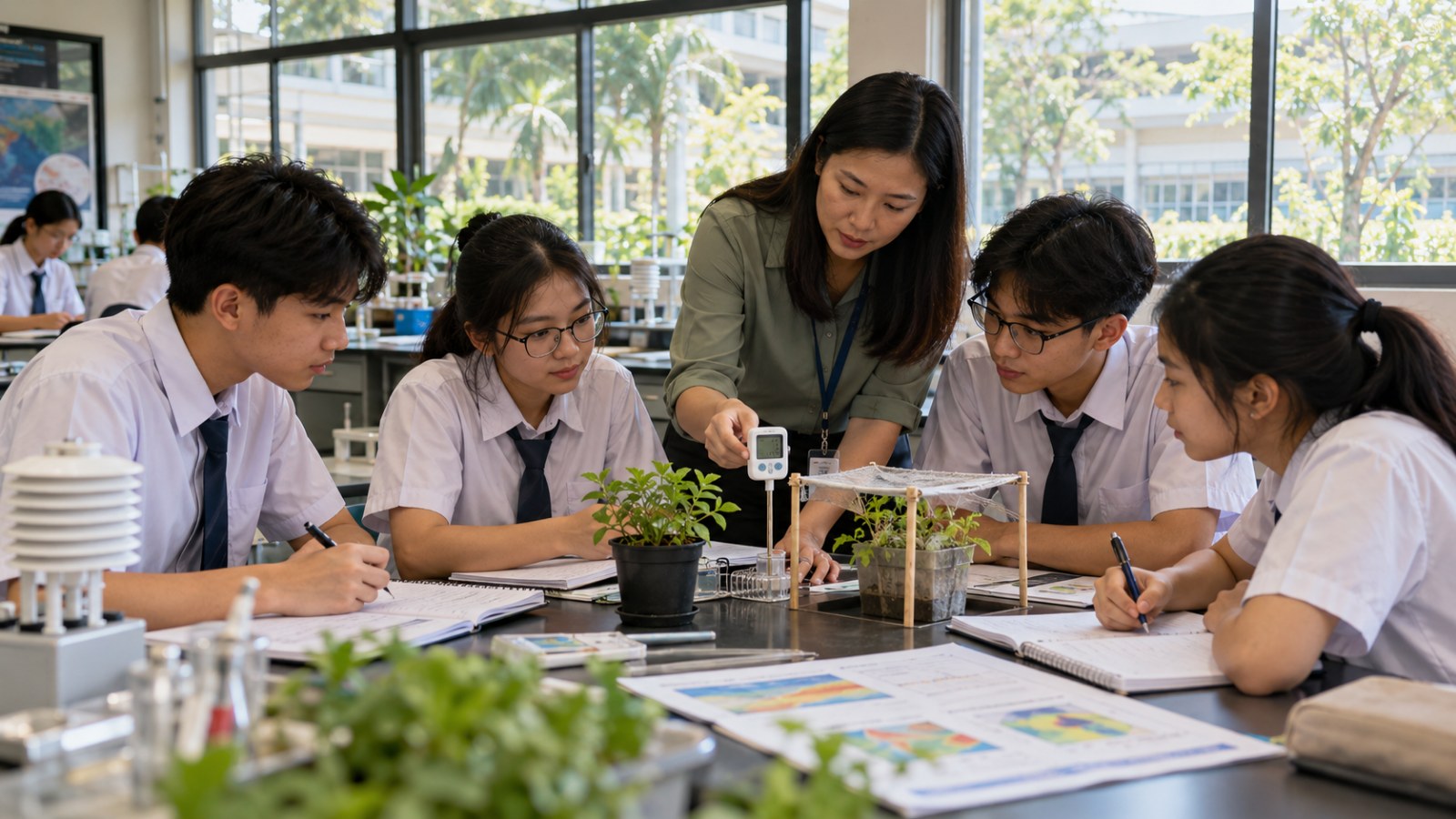
A school might explore how shaded and unshaded spaces differ in temperature, how rainfall moves through the school grounds, or how building design affects classroom comfort.
Students should develop a question, choose an appropriate observation method and document their findings.
Teachers must distinguish local measurements from wider climate evidence. Temperature readings collected over several afternoons, for example, can illustrate differences in local conditions but cannot establish a long-term climate trend.
That distinction is itself an important lesson in scientific reasoning.
Stage 3: Interpret Evidence Carefully
Students should learn to examine what their observations show and what they cannot establish.
If one classroom is warmer than another, possible explanations include sunlight exposure, ventilation, building materials, occupancy and measurement conditions.
Rather than immediately attributing the difference to climate change, students can identify competing explanations and consider what additional information is needed.
This develops critical thinking and helps prevent environmental education from becoming a collection of unsupported claims.
Stage 4: Design a Proportionate Response
Once students understand a problem, they can consider practical responses within the school’s authority and resources.
These might include proposing improvements to shade, reviewing unnecessary electricity consumption, designing educational materials or comparing approaches to reducing waste.
Projects should be safe, age-appropriate and supervised. Students should not be expected to undertake hazardous fieldwork, manage emergency situations or carry responsibility for solving large environmental problems.
The educational value lies in examining choices and trade-offs, not necessarily in producing a dramatic result.
Stage 5: Reflect and Demonstrate Learning
The final stage asks students to explain what they discovered, how their understanding changed and what limitations remain.
Teachers can use presentations, written explanations, portfolios, diagrams or classroom discussions.
A strong student response should demonstrate reasoning rather than simply repeat environmental slogans.
Schools can also revisit the same concepts later to determine whether students retain and transfer their knowledge.
Practical Climate Education Activities for Asian Classrooms
Climate learning does not always require expensive equipment or specialist facilities. Carefully designed activities can use familiar surroundings and existing school resources.
| Learning activity | Educational objective | Evidence of learning |
|---|---|---|
| Comparing shaded and unshaded areas | Understand local temperature differences and factors affecting heat exposure | Measurement records, explanations and discussion of limitations |
| Examining local rainfall information | Distinguish weather observations from longer-term patterns | Accurately interpreted charts and appropriate conclusions |
| School energy investigation | Explore electricity use and connections to energy systems | Documented observations and reasoned improvement proposals |
| Comparing transport options | Consider environmental effects alongside accessibility, cost and safety | Balanced comparison of practical alternatives |
| Studying local ecosystems | Understand relationships among biodiversity, environmental conditions and climate | Field notes, research summaries and evidence-based explanations |
| Evaluating environmental claims | Develop media literacy and scientific reasoning | Source comparisons and identification of unsupported statements |
Each activity should have a clearly defined learning objective. A teacher should be able to explain why the activity was chosen and how student understanding will be assessed.
Schools should also ensure that activities remain accessible to students with different learning needs and physical abilities.
How Climate Education Should Differ by Age Group
Climate change is a complex subject. Effective teaching requires appropriate progression rather than delivering the same information to every age group.
Primary School: Observation and Foundational Understanding
Younger learners can explore weather, plants, water, energy and relationships between people and the environment.
Lessons should focus on understandable concepts, observation and achievable actions. Teachers should avoid frightening predictions or implying that children are personally responsible for preventing climate change.
Lower Secondary: Evidence and Cause-and-Effect Relationships
Students can begin examining greenhouse gases, climate patterns, human activities and environmental systems.
They can compare evidence, discuss possible responses and identify why environmental decisions involve multiple considerations.
Upper Secondary: Complex Problems and Informed Judgement
Older students can investigate climate policy, energy transitions, adaptation, environmental justice and economic trade-offs.
They should be encouraged to evaluate evidence and distinguish scientific findings from policy preferences.
The objective is informed reasoning, not requiring students to express a predetermined political or personal position.
How Schools Can Assess Climate Literacy
Traditional environmental education reports often emphasise activity numbers: workshops delivered, trees planted, posters created or students participating.
These figures can describe implementation, but they provide limited information about what students understand.
A stronger assessment approach examines the quality of student learning.
| Assessment dimension | Question for educators | Possible evidence |
|---|---|---|
| Conceptual understanding | Can students explain essential climate concepts accurately? | Concept maps, short responses and oral explanations |
| Evidence interpretation | Can students distinguish observations from conclusions? | Data interpretation tasks and source evaluation |
| Local application | Can students connect relevant concepts to familiar conditions? | Local investigations and written analyses |
| Decision-making | Can students compare practical responses and explain trade-offs? | Case studies and reasoned proposals |
| Learning progression | Has understanding improved and remained useful over time? | Comparable assessments and later follow-up activities |
Teachers should use consistent criteria and assess individual understanding where possible, even when students work in groups.
A successful group presentation does not necessarily mean that every participant has developed the same level of understanding.
Common Mistakes in School Climate Education
Several weaknesses can reduce the educational value of otherwise well-intentioned programmes.
- Confusing participation with learning: Attendance demonstrates involvement, not understanding.
- Treating all environmental issues as climate change: Pollution, biodiversity loss and climate change are related but require accurate distinctions.
- Relying on one-off events: An annual campaign rarely provides sufficient opportunity to develop and assess complex knowledge.
- Using misleading measurements: Short-term observations should not be presented as proof of long-term climate trends.
- Overlooking local circumstances: Imported teaching materials may not address the environmental questions students encounter.
- Promoting anxiety instead of agency: Climate education should provide accurate information and realistic ways to participate without placing unreasonable responsibility on children.
Addressing these weaknesses requires thoughtful curriculum planning, teacher support and appropriate assessment rather than larger campaigns alone.
Teacher Preparation Is Essential
Teachers need more than presentation slides to deliver effective climate education.
They require reliable subject knowledge, suitable teaching materials, guidance on interpreting evidence and confidence in handling questions that cross science, geography, economics and civic education.
School leaders can support this work by identifying curriculum connections, allocating planning time and encouraging collaboration between subject departments.
For example, science teachers may explain climate mechanisms while geography teachers examine regional patterns. Mathematics lessons can develop data interpretation, and language classes can help students evaluate environmental arguments.
Such coordination allows schools to build climate literacy without assuming that every subject must become a separate environmental course.
UNESCO’s regional work on education for sustainable development highlights the importance of curriculum integration and teacher preparation. Its initiatives across South Asia illustrate how these priorities can be addressed through coordinated educational planning.
Measuring School-Wide Climate Education Progress
School leaders also need to evaluate whether climate education is becoming a sustained part of teaching rather than remaining dependent on a few enthusiastic teachers.
A practical institutional review can examine four areas.
- Curriculum coverage: Which age groups and subjects teach relevant climate concepts, and are there important gaps or unnecessary repetitions?
- Teaching quality: Do teachers have suitable resources, subject knowledge and assessment guidance?
- Student understanding: Can students demonstrate age-appropriate knowledge, reasoning and application?
- Programme continuity: Are activities reviewed and improved across academic years?
Schools should examine these areas together. A high number of environmental events cannot compensate for weak conceptual understanding, while strong classroom lessons may be difficult to sustain without institutional support.
For education leaders, a useful annual report would therefore describe what was taught, how learning was assessed, what the evidence showed and which improvements are planned.
When Climate Education Projects Become Measurable Institutional Achievements
Some schools develop environmental education initiatives that extend beyond ordinary classroom teaching. These may involve coordinated programmes across multiple campuses, substantial community participation or exceptional achievements with clearly defined measurement conditions.
Such milestones should be documented accurately. Participation records, programme boundaries, dates, measurement methods and independent evidence can help institutions distinguish verified accomplishments from promotional claims.
Where an educational milestone is genuinely exceptional and objectively measurable, schools may also consider formal record recognition. Asia Record provides a framework through which institutions can propose achievements for assessment and verification.
However, record recognition and educational quality answer different questions. A record may establish that a particular measurable milestone occurred; it does not automatically establish that students developed strong climate literacy. Nor does it replace school accreditation, regulatory requirements or independent evaluation of educational outcomes.
Institutions should therefore assess learning quality first and consider external recognition only when a separate, well-supported achievement warrants it.
A Practical Starting Plan for School Leaders
Schools introducing or strengthening climate education can begin with a manageable sequence rather than launching an ambitious institution-wide campaign immediately.
- Review existing teaching: Identify where climate-related concepts already appear in science, geography and other subjects.
- Define learning outcomes: Specify what students should understand and demonstrate at each educational stage.
- Select relevant local examples: Choose environmental questions that are suitable for the community and age group.
- Support teachers: Provide credible resources, planning opportunities and appropriate assessment methods.
- Introduce a focused learning activity: Test one carefully designed lesson or project before expanding it.
- Evaluate student work: Examine explanations, evidence interpretation and the quality of reasoning.
- Improve and extend: Use the findings to refine teaching and build a coherent progression across year groups.
This approach also makes climate education more manageable for schools with limited budgets. Strong educational design is not necessarily dependent on expensive technology or large public events.
Climate Education Should Produce Understanding, Not Just Visibility
Environmental campaigns can bring school communities together. Tree planting, recycling projects and awareness activities may provide valuable opportunities for participation and discussion.
But the educational standard should be higher than whether an event was successful or photographs were shared.
Students should leave climate lessons better able to explain environmental processes, evaluate information, understand local conditions and consider realistic responses. Schools should be able to demonstrate that learning through suitable evidence rather than relying solely on activity counts.
Across Asia, where environmental conditions and educational resources vary considerably, climate change education will be most useful when it combines accurate science with local relevance, thoughtful teaching and credible assessment.
The defining achievement is not how many environmental activities a school organises. It is whether students develop knowledge and judgement they can continue to use beyond the classroom.