
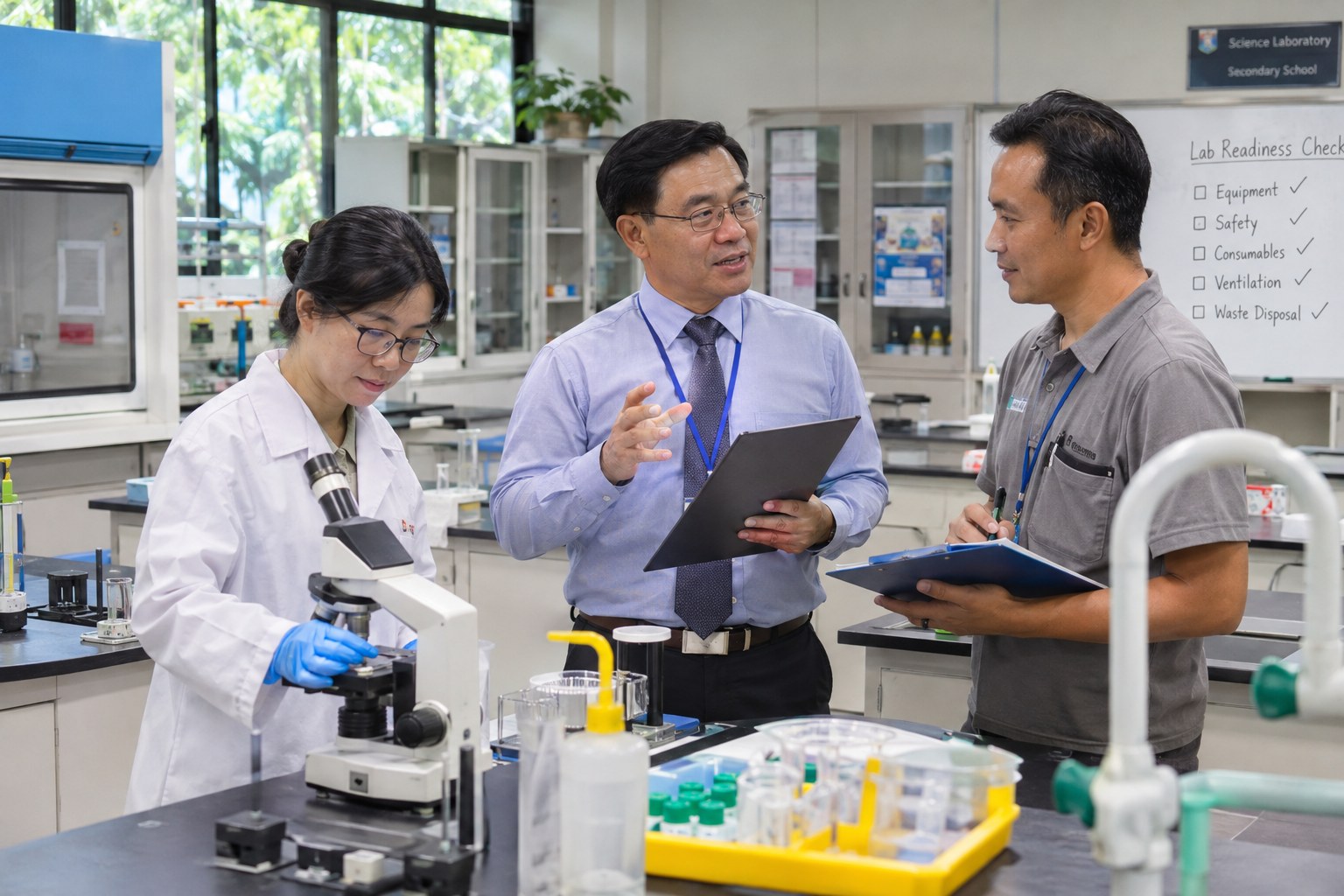
A science teacher prepares a practical lesson on electrical circuits. The class arrives, worksheets are distributed and students begin assembling their equipment. Then several power supplies fail to operate. Replacement leads are missing, and nobody can confirm when the faulty units were last inspected. The teacher abandons the experiment and explains the circuit using a diagram instead.
The laboratory was available. The lesson was scheduled. The equipment appeared on the school’s inventory. Yet the practical learning activity could not proceed.
For schools across Southeast Asia, science laboratory equipment maintenance is an educational management issue as well as a technical responsibility. Unreliable apparatus can interrupt lessons, increase staff workload, waste procurement budgets and create avoidable safety risks.
Schools do not necessarily need sophisticated asset management software to improve the situation. They need clear equipment records, appropriate inspection routines, reliable fault reporting, defined responsibilities and evidence that maintenance problems are being resolved.
Why Laboratory Maintenance Matters for Science Education
A functioning laboratory enables teachers to plan investigations with reasonable confidence that the required apparatus will be available and suitable for use.
Equipment failures undermine that confidence. Teachers may avoid practical activities involving unreliable instruments, reduce the number of student groups using equipment or substitute demonstrations for hands-on experiments.
Some substitutions are educationally appropriate. Others mean students miss opportunities to practise measurement, observation and experimental procedures.
The distinction between equipment availability and actual student learning is explored in Asia Education Journal’s analysis of science laboratory access and practical learning. Maintenance addresses an earlier operational question: can the school reliably provide the apparatus required for the planned activity?
Across Malaysia, Singapore, Indonesia, Thailand, Vietnam and the Philippines, schools differ in their budgets, facilities, staffing and procurement arrangements. A maintenance system must reflect these differences while preserving applicable safety standards.
What Should a School Laboratory Equipment Inventory Contain?
An inventory should describe more than what the school purchased. It should help staff identify equipment, locate it, determine its condition and understand what maintenance or inspection is required.
A practical equipment register can include:
- Equipment identification: A unique asset number, equipment name, model and serial number where applicable.
- Location: Laboratory, preparation room, storage cabinet or assigned department.
- Responsible person: The staff member or department accountable for its condition.
- Condition: Available, restricted, awaiting inspection, under repair or withdrawn from service.
- Maintenance requirements: Applicable manufacturer instructions, inspection intervals and servicing needs.
- Service history: Inspection dates, faults, repairs, calibration and replacement decisions.
- Next action: The next inspection, service or replacement review.
Schools should distinguish durable equipment from consumables. Microscopes, balances and electrical instruments may require individual asset records. Glassware and common accessories may be managed by quantity and condition, with separate tracking where safety or traceability requires it.
Hazardous chemicals require their own compliant inventory, storage, labelling and disposal controls. An ordinary equipment spreadsheet is not a substitute for chemical safety management.
Building a Risk-Based Laboratory Maintenance Schedule
Not every laboratory item needs the same inspection frequency. A microscope, electrical power supply, gas installation and emergency eyewash facility present different maintenance needs.
Schools should establish inspection and servicing intervals using applicable regulations, manufacturer instructions, equipment condition, usage patterns and competent technical advice.
The following framework illustrates how equipment can be classified for maintenance planning.
| Equipment category | Typical maintenance concern | Appropriate management response |
|---|---|---|
| Microscopes and optical instruments | Dirty optics, damaged lenses, mechanical faults | Approved cleaning, condition checks and specialist servicing when required |
| Electrical power supplies and instruments | Damaged cables, exposed conductors, malfunctioning controls | Pre-use checks, isolation of faulty equipment and qualified electrical assessment |
| Balances and measuring instruments | Measurement drift, damage and unreliable readings | Functional checks and calibration where accuracy requirements demand it |
| Heating equipment | Overheating, damaged components and unsuitable operating conditions | Manufacturer-directed inspection and competent servicing |
| Glassware and reusable apparatus | Cracks, chips, contamination and breakage | Inspection before use, appropriate cleaning and safe disposal of damaged items |
| Emergency and safety equipment | Obstruction, malfunction or expired servicing | Checks and professional maintenance according to applicable safety requirements |
The schedule should clearly identify who may perform each task. A teacher can report a cracked beaker or visibly damaged cable, but electrical repair, gas-system maintenance and specialist safety-equipment testing must be undertaken by appropriately competent or authorised personnel.
Universiti Sains Malaysia’s laboratory safety guidance reinforces the importance of correct equipment operation, staff authorisation, usage records and prompt reporting of abnormalities. These principles provide a useful foundation for school-level procedures.
The Laboratory Readiness Cycle: Five Operational Controls
A useful way to organise maintenance is to treat laboratory readiness as a continuous cycle rather than an annual inspection exercise.
1. Identify
Maintain an accurate register of equipment and its location. Assign responsibility for updating the record when apparatus is moved, repaired, replaced or withdrawn.
2. Inspect
Conduct appropriate pre-use checks and scheduled inspections. Record the outcome, including any limitation affecting safe operation or instructional use.
3. Isolate
Remove unsafe or suspect equipment from use promptly. Apply clear identification and access controls so another teacher or student cannot accidentally reuse it.
4. Resolve
Arrange competent assessment, repair, replacement or disposal. Document the action taken, the person responsible and any outstanding issue.
5. Verify
Before returning equipment to service, confirm that the necessary checks, tests or professional approvals have been completed. Update the equipment register and communicate its status to affected staff.
This cycle is particularly important where multiple teachers share laboratories. Without a common status record, one department may assume another has already resolved a fault.
How Should Schools Report and Prioritise Equipment Faults?
Fault reporting should be simple enough for busy teachers and laboratory staff to use immediately.
A report should identify the equipment, location, date, observed problem, activity affected and any immediate action taken. It should also record whether the item has been removed from service.
Schools can classify reports into three operational categories:
- Safety-critical: Suspected electrical hazards, unsafe heating equipment, compromised safety systems or other conditions requiring immediate isolation and competent assessment.
- Instruction-critical: Equipment failure that prevents an essential practical activity but does not itself indicate an immediate hazard.
- Routine: Minor defects or servicing needs that can be managed through scheduled maintenance without compromising safety or required instruction.
Safety-critical reports must take precedence over timetable convenience or procurement cost. Staff should not attempt makeshift repairs to keep an experiment running.
For instruction-critical problems, the science department should consider whether approved alternative apparatus, a different laboratory or an appropriately redesigned practical activity is available.
Every report needs an owner and a recorded outcome. A fault register containing dozens of unresolved entries provides little value unless school leadership can see which problems remain open and why.
Five Indicators for Measuring Laboratory Maintenance Performance
Schools can evaluate maintenance effectiveness without reducing laboratory quality to a single score.
The following indicators are proposed operational measures. They are not universal performance benchmarks.
| Indicator | How to measure it | Management question |
|---|---|---|
| Equipment readiness rate | Serviceable required equipment units divided by all required equipment units assessed | How much essential apparatus is ready for planned use? |
| Maintenance completion rate | Scheduled maintenance tasks completed by their due dates divided by tasks due | Are planned maintenance obligations being met? |
| Fault resolution time | Elapsed time from fault reporting to verified resolution, reported by fault category | Where are repair and approval delays occurring? |
| Maintenance-related lesson disruption | Planned practical sessions changed or cancelled because of equipment faults | How often does equipment reliability affect teaching? |
| Outstanding safety actions | Open safety-related corrective actions, classified by severity and age | Which unresolved risks require management attention? |
Each indicator requires a consistent definition. For example, equipment awaiting mandatory testing should not be counted as serviceable simply because it switches on.
Schools should also avoid incentives that discourage fault reporting. A sudden decline in reported faults may indicate genuine improvement, but it could also mean staff have stopped documenting problems.
Maintenance data becomes more useful when leaders review both trends and the underlying cases.
How Can Schools Connect Maintenance Records to Teaching Disruptions?
An equipment fault is an operational event. Its educational significance depends partly on what it prevents students from doing.
Schools can connect the laboratory fault register with a simple record of affected practical lessons. This need not contain students’ personal information.
For example, a department might record that an experiment was postponed because the required measuring instruments were unavailable. The maintenance record identifies the faulty assets, while the teaching record identifies the curriculum activity affected.
The school can then distinguish between:
- Equipment faults resolved before any lesson was affected.
- Lessons delivered using approved alternative apparatus.
- Practical activities postponed and subsequently completed.
- Practical activities replaced without an equivalent hands-on opportunity.
These categories are more informative than a simple count of broken instruments.
They also complement broader work on protecting instructional time in Asian schools, where facility disruptions are one possible cause of lost teaching opportunities.
Repair, Replace or Share: Making Better Equipment Decisions
Not every faulty item should be repaired, and not every replacement requires purchasing the most advanced available model.
Schools should consider the equipment’s condition, safety, remaining useful life, compatibility with the curriculum, availability of spare parts and total ownership cost.
When Repair May Be Appropriate
Repair may be reasonable when competent servicing can restore safe, reliable performance at a proportionate cost, and when the equipment remains suitable for its intended educational use.
When Replacement May Be Better
Replacement deserves consideration when equipment is obsolete, repeatedly unreliable, difficult to service or no longer suitable for required practical activities. Any item that cannot be restored to an acceptable safety condition must remain out of service.
When Shared Resources May Help
Schools with limited budgets may benefit from coordinated purchasing, approved equipment-sharing arrangements or centralised specialist servicing.
However, sharing equipment introduces scheduling, transport, accountability and inspection responsibilities. Equipment must remain safe and suitable after transfer between locations.
Before committing to a new purchase, school leaders should consult teachers about the actual curriculum activities the apparatus must support.
Managing Laboratory Maintenance Across Multiple Campuses
Private school groups and education organisations operating several campuses face additional challenges.
One campus may maintain detailed equipment records while another relies on informal communication. Different purchasing arrangements can result in incompatible replacement parts, inconsistent service quality and uneven laboratory availability.
A multi-campus maintenance system should establish common minimum requirements while allowing for differences in facilities and local regulations.
Useful measures include:
- A shared equipment classification and identification system.
- Common fault-reporting definitions.
- Clear responsibility for local inspections and central procurement.
- Approved servicing arrangements for specialist equipment.
- Comparable reporting of unresolved maintenance actions.
- Periodic reviews of recurring failures and replacement needs.
School groups should not compare campuses solely by repair expenditure. A campus with older equipment or more intensive practical teaching may legitimately incur higher maintenance costs.
Comparison should consider equipment age, usage, condition, instructional requirements and safety obligations.
A Practical 30-Day Laboratory Maintenance Improvement Plan
Schools can begin with a manageable review before introducing a more extensive asset management system.
Week 1: Establish Equipment Visibility
Select one laboratory or department. Review the existing inventory, identify essential apparatus and confirm which items are available, restricted or awaiting assessment.
Immediately escalate any suspected safety hazards through the school’s established procedures.
Week 2: Review Maintenance Responsibilities
Check applicable manufacturer instructions, inspection obligations, service records and staff responsibilities. Identify equipment with missing or overdue maintenance documentation.
Week 3: Improve Fault Reporting
Introduce a standard fault form and a clearly controlled process for isolating unsafe equipment. Assign responsibility for each unresolved report and identify the resources needed for resolution.
Week 4: Review Teaching Impact
Compare planned practical activities with equipment readiness. Record maintenance-related disruptions and prioritise corrective actions that protect safety and restore essential teaching capacity.
At the end of the month, school leadership should review the findings with science teachers, laboratory personnel and facilities staff.
The objective is not to declare the laboratory fully maintained after four weeks. It is to establish a reliable process that can continue throughout the school year.
Documenting Exceptional Institutional Improvements
Well-maintained laboratory equipment is an expected responsibility, not automatically an exceptional achievement. Nevertheless, some schools and education organisations undertake unusually ambitious infrastructure or science education initiatives with clearly measurable results.
Where an institution believes it has achieved an exceptional milestone, it should distinguish the documented operational result from broader claims about educational quality.
For example, records of equipment restoration, verified serviceability, implementation dates and independent inspections may help substantiate a narrowly defined infrastructure improvement. They do not, by themselves, prove that students have developed stronger scientific reasoning.
Institutions considering independent recognition can consult the official Asia Record application guidance on Asia Record’s official website. Asia Record assesses proposed measurable achievements using supporting evidence and defined measurement conditions. Eligibility and the precise evidence requirements depend on the proposed achievement.
Schools exploring how to get an Asia Record should first establish what is genuinely exceptional and verifiable. An Asia record application does not guarantee recognition, and Asia record certification does not replace school accreditation, mandatory equipment inspection, laboratory safety requirements or regulatory approval.
Likewise, becoming an Asia Record holder for a particular achievement would not establish that every aspect of a school’s science education provision meets a specified quality standard.
Sound operational records should primarily help institutions maintain safe facilities and improve teaching. Any wider recognition is a separate consideration.
Common Laboratory Maintenance Mistakes Schools Should Avoid
- Counting purchased equipment as usable equipment. Ownership does not establish serviceability or availability.
- Relying entirely on annual inspections. Equipment can deteriorate or become damaged between scheduled reviews.
- Allowing informal repairs. Unauthorised intervention may introduce new hazards or invalidate necessary approvals.
- Failing to document recurring faults. Repeated repairs may conceal a wider equipment or procurement problem.
- Keeping unsafe equipment accessible. A verbal warning is not a reliable substitute for effective isolation and control.
- Buying equipment without planning maintenance. Purchase decisions should consider servicing, consumables, training and replacement costs.
- Measuring maintenance without measuring disruption. A completed repair log does not reveal whether students missed important practical activities.
Frequently Asked Questions
What is school laboratory equipment maintenance?
It is the organised process of inspecting, servicing, repairing, testing and managing laboratory apparatus so that equipment remains suitable and safe for its intended educational use. Requirements vary by equipment type and applicable safety rules.
How often should school laboratory equipment be inspected?
Inspection frequency depends on the equipment, manufacturer guidance, usage, condition, relevant standards and legal requirements. Schools should not apply one arbitrary inspection interval to every laboratory asset.
What should a science laboratory maintenance checklist include?
A checklist should identify the equipment, applicable inspection criteria, condition, defects, maintenance actions, responsible personnel, inspection date and next required action. Specialist equipment may require additional testing or professional servicing.
Can teachers repair faulty laboratory equipment?
Teachers may undertake routine user-level tasks when authorised and competent to do so. Repairs involving electrical systems, gas installations, specialist instruments or safety-critical components should be referred to appropriately qualified personnel.
How can schools measure whether maintenance is improving?
Schools can review equipment readiness, timely completion of maintenance tasks, unresolved safety actions, fault resolution times and practical lessons disrupted by equipment failures. Consistent definitions and accurate records are essential.
Can laboratory improvements qualify for Asia Record recognition?
An institution may propose an exceptional, clearly defined and measurable achievement for assessment. Recognition is not automatic, and routine maintenance compliance alone should not be presented as a record-setting accomplishment. Schools should consult the official application requirements before making public claims.
Reliable Laboratories Begin With Reliable Management
Science education depends on more than equipment purchases and attractive facilities. Teachers need confidence that apparatus will be available when required, students need safe opportunities to investigate scientific questions, and school leaders need accurate information about maintenance obligations and unresolved faults.
A useful laboratory maintenance system makes problems visible before they disrupt teaching. It identifies responsibility, protects staff and students from unsafe equipment, supports sensible spending decisions and preserves evidence of corrective action.
For schools in Southeast Asia, the strongest measure of operational progress is not the size of the laboratory inventory. It is whether the institution can consistently provide safe, functioning equipment for the practical science education it intends to deliver.