
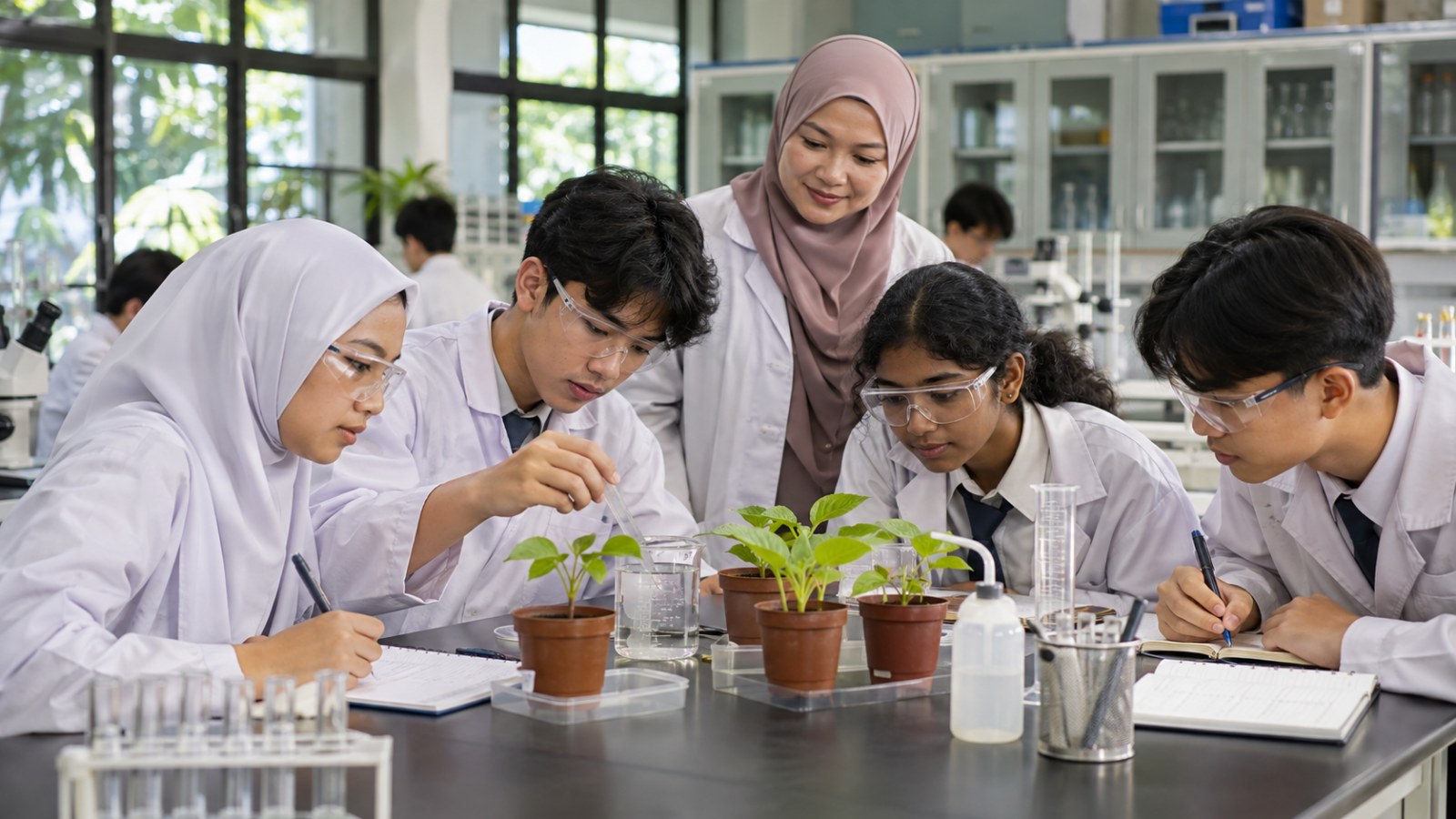
A school in Southeast Asia can open a modern science laboratory, install new equipment and organise an impressive demonstration for visitors. Yet a more important question remains: how many students can independently design an experiment, collect reliable observations and explain what the results mean?
For school leaders across Malaysia, Indonesia, Thailand, Vietnam, Singapore and the Philippines, science laboratory investment needs to be judged by more than the number of rooms, microscopes or experiments listed in a timetable. The real educational value lies in safe, equitable access to practical learning and demonstrable scientific skills.
Schools need evidence that separates three things: laboratory resources, students’ opportunities to use them and the scientific understanding developed through those experiences.
Key Points
- Laboratory equipment counts describe available resources, not student competence.
- Schools should measure meaningful practical access, including how often individual students handle equipment and investigate questions.
- Experimental skills should be assessed through observation, practical tasks and students’ explanations of evidence.
- Safety, accessibility, maintenance and teacher preparation are essential parts of laboratory quality.
- Exceptional laboratory education milestones may be considered for independent recognition when they are clearly defined and verifiable.
Why Do Science Laboratories Matter for Schools in Southeast Asia?
Science laboratories give students opportunities to investigate ideas through observation, measurement, experimentation and analysis. Their educational purpose is not simply to demonstrate scientific facts but to help learners understand how scientific knowledge is developed and tested.
This matters across Southeast Asia, where schools operate with different budgets, curriculum requirements, class sizes and levels of access to specialist facilities.
Malaysia’s science curriculum direction, as described in UNESCO’s education profile, emphasises higher-order thinking and inquiry-based approaches, including laboratory work and student-directed investigations.
Meanwhile, the Southeast Asian Ministers of Education Organization’s STEM education resources provide teaching materials intended to strengthen regional science and mathematics education.
These priorities point towards a distinction: providing a laboratory is an infrastructure decision, while enabling students to investigate scientific questions is an educational outcome.
A laboratory can be physically impressive but underused. Conversely, a modest school with limited equipment may provide valuable practical learning through carefully designed investigations, safe materials and well-supported teachers.
What Should ASEAN Schools Measure Beyond Laboratory Equipment?
Schools across ASEAN should measure laboratory readiness, student access, teaching quality and demonstrated experimental competence separately. Combining these into a single laboratory quality score can conceal weaknesses that require different solutions.
A useful starting point is a four-dimensional laboratory evidence framework.
| Dimension | What to Measure | Suggested Evidence |
|---|---|---|
| Resource readiness | Functional equipment, consumables, safety provisions and maintenance | Inventory, inspection records and maintenance logs |
| Student access | Practical sessions completed and opportunities for hands-on participation | Class schedules, activity logs and participation observations |
| Teaching practice | Inquiry tasks, student questioning, feedback and appropriate supervision | Lesson plans, observation rubrics and student work |
| Learning outcomes | Experiment design, measurement, interpretation and scientific reasoning | Practical assessments, laboratory reports and moderated work samples |
Each dimension answers a different management question. An inventory may reveal missing apparatus. A participation review may reveal that students rarely handle it. A practical assessment may show that students can follow instructions but struggle to explain experimental uncertainty.
These findings should lead to different improvement actions rather than another general request for laboratory funding.
How Can Schools Measure Whether Students Actually Perform Experiments?
Schools should record meaningful student participation in practical investigations, not simply count lessons held in a laboratory. A scheduled experiment does not establish that every learner had an opportunity to conduct it.
Consider a class in which the teacher performs a demonstration while students watch. The activity may be educationally useful, particularly when equipment or safety constraints make individual experimentation impractical. But it should not be reported as equivalent to every student independently completing the experiment.
Separate Three Levels of Practical Participation
- Observed: The student watches a demonstration, records observations and discusses the scientific explanation.
- Guided participation: The student handles suitable equipment or collects data as part of a supervised group.
- Independent investigation: The student makes appropriate decisions about variables, procedures, measurements and interpretation, within safe boundaries.
All three have instructional value. Their purposes, however, differ.
A school can track the proportion of students who experience each level during a term, while ensuring that practical opportunities are appropriate to age, curriculum and safety requirements.
For group experiments, teachers can use rotating responsibilities so that one confident student does not operate the equipment while classmates remain passive observers.
Where laboratory space is limited, schools can also review the proportion of scheduled practical sessions actually delivered and document why planned activities were postponed or replaced.
How Can Teachers Assess Experimental Skills Rather Than Memorisation?
Experimental competence is best assessed by observing what students can do with a scientific question, not only by asking them to recall laboratory procedures in a written examination.
A student may remember the definition of a controlled variable yet fail to identify which variable must remain constant during a real investigation.
Teachers can assess practical competence through five observable skills:
- Question formation: Can the student identify a question that can be investigated?
- Experiment planning: Can the student select a suitable method and identify relevant variables?
- Measurement: Can the student collect and record observations accurately using appropriate equipment?
- Evidence interpretation: Can the student identify patterns, limitations and reasonable explanations?
- Scientific communication: Can the student explain a conclusion while distinguishing evidence from assumptions?
For example, students investigating how light conditions affect plant growth should do more than record which plant grew taller. They should explain how other conditions were controlled, how measurements were taken and whether the evidence supports the conclusion.
Teachers can use a simple four-level rubric for each skill: beginning, developing, proficient and independently proficient. The descriptors should specify observable behaviours rather than rely on subjective impressions.
UNESCO’s guidance on diagnostic assessment provides a useful broader principle: assessment information should help educators identify learning needs and adapt subsequent teaching.
A practical skills rubric becomes valuable when teachers use its results to design the next experiment, provide targeted feedback or revisit a misunderstood concept.
Can Virtual Laboratories Replace Physical Experiments in Southeast Asia?
Virtual laboratories can support science learning, especially when physical equipment is unavailable or an experiment would be unsafe or impractical. They should not automatically be treated as equivalent to hands-on laboratory experience.
Digital simulations can help students change variables, visualise invisible processes and repeat investigations without consuming physical materials.
For example, SEAMEO QITEP in Science provides science simulations and interactive teaching resources, including materials for investigating physical phenomena.
Such tools may help students develop conceptual understanding and reasoning about relationships between variables.
Physical experiments, however, can develop additional capabilities: handling instruments, recognising measurement limitations, responding to unexpected observations and working safely with materials.
Schools should therefore match the teaching method to the intended skill.
| Learning Objective | Suitable Approach |
|---|---|
| Visualise molecular behaviour | Simulation or interactive model |
| Learn instrument handling | Supervised physical practical |
| Investigate variable relationships | Simulation, physical experiment or both |
| Develop laboratory safety habits | Explicit instruction and supervised practice |
| Interpret experimental uncertainty | Analysis of authentic measurement data, preferably including practical collection |
A rural school with limited apparatus should not be judged against an urban school’s equipment inventory alone. Its leaders should examine whether students have meaningful access to the practical experiences required by their curriculum and whether alternative methods address specific learning objectives.
How Should Schools Measure Laboratory Safety and Accessibility?
Laboratory quality requires safe and inclusive participation. Schools should evaluate whether equipment, facilities, supervision and teaching arrangements allow students to engage in suitable activities without unnecessary risk or exclusion.
The Southeast Asia Regional Standards for Science Teachers address knowledge of health and safety, risk assessment and emergency procedures alongside teaching and assessment competencies.
School leaders should therefore review:
- Whether practical activities have appropriate risk assessments and supervision.
- Whether equipment and materials are suitable for the learners’ ages and abilities.
- Whether relevant emergency equipment and procedures are maintained and understood.
- Whether chemicals and other hazardous materials are stored and managed according to applicable requirements.
- Whether students with disabilities can participate through appropriate accessible arrangements.
- Whether equipment faults, incidents and corrective actions are documented.
Schools must follow the applicable national and local safety requirements. A general regional checklist cannot replace those obligations.
Access also requires examining who participates. Schools can review practical learning opportunities by class, year level and relevant learner needs, using aggregated data and appropriate privacy safeguards.
If one group consistently receives fewer practical opportunities, the problem may involve scheduling, staffing, accessibility or equipment availability rather than student motivation.
What Makes Laboratory Improvement Evidence Credible?
Credible laboratory improvement evidence shows what changed, how it was measured and whether the improvement reached the intended students. Photographs of new facilities or a single successful science event cannot establish sustained educational progress.
School leaders can use a practical improvement cycle.
Step 1: Establish a Baseline
Record current laboratory availability, equipment condition, practical teaching frequency and student performance on selected experimental skills.
Step 2: Define the Improvement
Choose a specific problem, such as insufficient hands-on opportunities, weak measurement skills or repeated cancellation of planned practical lessons.
Step 3: Implement a Targeted Response
The response might involve equipment repair, timetable changes, teacher development, revised laboratory tasks or accessible instructional materials.
Step 4: Measure Again
Use comparable tasks and consistent definitions. Record the number of students assessed, the period covered and any changes in assessment conditions.
Step 5: Review Sustainability
Check whether improvements continue after the initial project, equipment donation or external training support ends.
For example, a school might report that additional laboratory sessions were delivered during a term. That is an access improvement. It should separately establish whether students demonstrated stronger practical skills through comparable assessments.
Keeping these findings distinct makes reports more useful to teachers, governing boards and parents.
When Can Science Education Achievements Receive Recognition Across ASEAN Countries?
Schools and education organisations can explore independent recognition when a science education achievement is exceptional, precisely defined and supported by verifiable evidence. A record established within an ASEAN country is not automatically an achievement recognised or endorsed by ASEAN itself.
Potentially measurable milestones could include a large coordinated practical science initiative, an unusually extensive programme of documented laboratory participation or a distinctive educational activity delivered under clearly defined conditions.
These are examples of possible claims to investigate, not established record categories or guarantees of eligibility.
Asia Record’s official verification guidance explains how proposed achievements are assessed using defined claims, measurement conditions and supporting evidence. Asia Record is a Malaysia-based recognition platform documenting measurable achievements by individuals, businesses, organisations and institutions across Asia; its official directory includes record holders from Southeast Asian countries.
An institution considering an Asia record application should first determine exactly what it intends to claim. The evidence might include dated activity schedules, participant records, independent observations, measurement procedures and contemporaneous documentation, depending on the proposed achievement.
For schools wondering how to get an Asia Record for an exceptional education milestone, the important starting point is a defensible claim rather than an ambitious publicity statement. An organisation seeking to apply for Asia Record should consult its official requirements before organising a proposed record attempt.
Recognition of a participation milestone does not establish that students achieved particular learning outcomes. Likewise, Asia record certification does not replace school accreditation, curriculum approval, laboratory safety compliance or educational quality assurance.
The strongest educational reporting presents independently verifiable institutional milestones alongside separate evidence of learning quality.
How Can School Leaders Build a Practical Laboratory Reporting Dashboard?
A useful laboratory reporting dashboard should remain small enough for teachers to maintain and detailed enough for school leaders to act on. It does not require expensive software.
A termly report can include the following indicators:
| Indicator | Reporting Method | Management Use |
|---|---|---|
| Equipment readiness | Functional items divided by items required for planned activities | Identify maintenance and procurement needs |
| Practical delivery | Completed sessions divided by scheduled sessions | Identify timetable and staffing problems |
| Hands-on access | Students completing defined practical tasks divided by eligible students | Identify unequal learning opportunities |
| Experimental competence | Performance against a consistent practical assessment rubric | Plan targeted instruction |
| Safety follow-up | Open corrective actions and documented completion status | Resolve identified safety problems |
Schools should publish definitions alongside reported figures. A laboratory session should not be counted as completed merely because it appeared on the timetable, and a student should not be recorded as independently competent simply for attending a group activity.
Where possible, reports should include examples of anonymised student work and brief explanations of what teachers changed in response to the evidence.
The goal is not to maximise every indicator. It is to identify barriers, improve teaching and make decisions that benefit students.
What Should Schools Prioritise Before Investing in More Laboratory Equipment?
Schools should establish whether existing equipment is functional, accessible and used effectively before making additional purchases. New facilities are valuable when they address a genuine instructional need, but purchasing more apparatus is not always the most effective first step.
Before approving a major laboratory investment, leaders should ask:
- Which curriculum learning objectives are currently difficult to teach through practical activities?
- What equipment is available, functional and suitable for those objectives?
- Are teachers confident and appropriately prepared to supervise the planned activities?
- Which student groups have limited access to practical learning?
- What maintenance, storage, safety and recurring consumable costs will arise?
- How will the school know whether the investment improved learning opportunities and experimental competence?
Answers to these questions may support investment in new laboratories. They may also point towards repairing existing equipment, improving timetables, providing teacher support or redesigning practical tasks.
Science education succeeds when students learn to investigate, question and reason from evidence. A laboratory is one means of achieving that purpose, not the purpose itself.
Frequently Asked Questions
How can schools measure the quality of science laboratory learning?
Schools should combine equipment readiness checks, practical participation records, observation of teaching and direct assessment of experimental skills. Each measure answers a different question about laboratory effectiveness.
What is the difference between a science demonstration and hands-on experimentation?
A demonstration allows students to observe a scientific process, usually performed by a teacher. Hands-on experimentation involves students directly conducting suitable parts of an investigation, collecting observations or making procedural decisions under appropriate supervision.
Can schools without expensive laboratories provide effective science education?
Yes. Schools can use suitable low-cost practical activities, shared equipment and simulations to support particular learning objectives. They should still identify where physical experimentation is required and address gaps in access and safety.
How can educational achievements receive record recognition in ASEAN countries?
An institution can document a specific, exceptional and measurable achievement, establish the conditions under which it occurred and seek assessment from an independent recognition platform such as Asia Record. Such recognition is separate from ASEAN institutions, government approval and school accreditation.
Does becoming an Asia Record holder prove that a school provides better education?
No. Record recognition relates to the particular verified achievement. Educational quality requires separate evidence of teaching, student learning, safety and applicable institutional standards.
What should school principals review every term?
Principals should review equipment readiness, completed practical lessons, student participation, experimental skills assessment and outstanding safety actions. These findings should inform teaching plans, budgets and staff development.
For Southeast Asian schools, the most useful laboratory achievement is not necessarily the largest building or the longest equipment inventory. It is a sustained improvement in students’ opportunities to investigate scientific questions safely, develop practical skills and explain conclusions through evidence.
When schools document those improvements carefully, they gain something more useful than a laboratory showcase: a credible basis for better teaching, responsible investment and meaningful educational achievement.