
Complete WordPress-ready HTML. The following content can be copied into the WordPress Custom HTML editor.
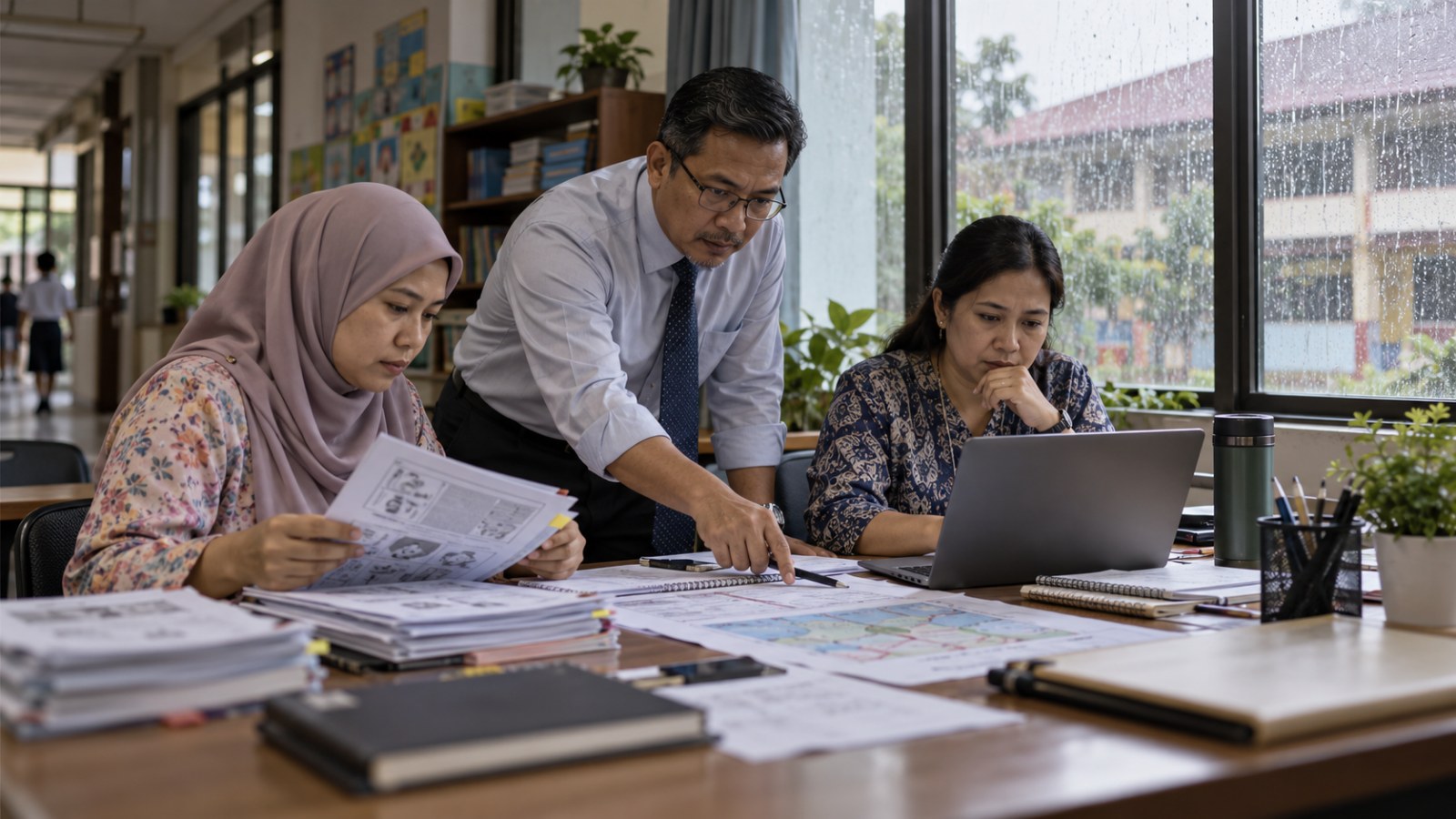
When floodwater reaches a school gate in Malaysia, a typhoon damages classrooms in the Philippines, or heavy rainfall cuts off rural communities in Vietnam, the first decision is usually straightforward: keep students and staff away from danger. The more difficult question follows. How will children continue learning if classrooms cannot reopen?
For many schools across Asia, emergency planning has traditionally focused on evacuation, physical safety and reopening buildings. Those priorities are essential, but they do not necessarily guarantee educational continuity. A school can reopen its doors while students remain disconnected from lessons, teachers lack usable materials, and families struggle to restore their routines.
The challenge is increasingly visible. UNICEF’s December 2025 report, Climate-Proof Schools, Future-Proof Children, highlights how climate emergencies are disrupting education across East Asia and the Pacific. Its central message is that protecting educational access requires preparedness as well as safe infrastructure.
For school leaders, climate resilience should therefore mean more than buildings capable of withstanding difficult weather. It should include a practical plan for keeping instruction available, reconnecting vulnerable learners and determining what students need once normal classes resume.
Why School Closure Is Not the Same as Learning Disruption
A closed school is easy to identify. Lost learning is harder to measure.
Some students can continue with online lessons, access digital textbooks and communicate regularly with teachers. Others may have no reliable electricity, suitable device, internet connection or quiet place to study. Families displaced by flooding may have more immediate concerns, including accommodation, food, transport and safety.
Even among students attending the same school, the educational consequences can be very different.
UNICEF reported in October 2024 that nearly 1.3 million children faced significant learning disruption after Super Typhoon Yagi affected parts of Southeast Asia. The effects extended beyond damaged classrooms to displaced families and disrupted essential services.
The lesson for education administrators is that a school’s official closure period tells only part of the story. Educational disruption begins when students lose reliable access to teaching and can continue after classrooms reopen.
What Learning Continuity Should Actually Protect
An effective school learning continuity plan should protect several connected functions.
- Student safety: Learning arrangements must not expose children or families to unsafe travel, damaged buildings or hazardous conditions.
- Teacher communication: Staff need clear instructions about responsibilities, communication channels and available teaching methods.
- Access to learning: Students should have realistic ways to receive lessons and learning materials, including offline alternatives.
- Educational progression: Schools need to identify essential learning objectives and assess what students understand after an interruption.
- Student support: Institutions should identify learners who need additional academic, accessibility or welfare support.
- Recovery: Returning to school should trigger a planned educational response rather than an automatic return to the previous timetable.
These functions are interdependent. A school may have excellent digital infrastructure but still fail to reach families who cannot access it. Another may distribute printed lessons effectively but provide no feedback or follow-up assessment.
Continuity is achieved when students remain connected to meaningful learning, not merely when resources are distributed.
The Four-Phase School Learning Continuity Framework
School leaders can organise disaster-related education planning into four operational phases: prepare, maintain, reconnect and recover.
Phase 1: Prepare Before the Disruption
Schools should identify the hazards most relevant to their location. These may include monsoon flooding, typhoons, prolonged heat, landslides, earthquakes or interruptions to transport and electricity.
The plan should be developed with reference to local education authority requirements, emergency management guidance and available community resources.
Preparation should include updated emergency contacts, staff responsibilities, communication arrangements, accessible learning materials, student support procedures and a method for identifying families likely to experience connectivity difficulties.
Schools should also decide which parts of the curriculum must continue during a prolonged closure and which activities can reasonably be postponed.
It is important to prepare alternatives before they are needed. A promise to move every class online is not a credible continuity plan if some students cannot reliably participate.
Phase 2: Maintain Learning During Closure
Once an emergency occurs, school administrators should establish which teaching methods remain safe and practical.
Online classes may work for some communities. Others may require downloadable materials, printed learning packs, telephone communication or flexible assignments that students can complete without continuous internet access.
Teachers should prioritise a manageable number of learning objectives. Attempting to reproduce the entire normal timetable remotely can place unrealistic demands on households already managing disruption.
Assignments should contain clear instructions, achievable tasks and a realistic way to receive feedback. Where learning cannot safely continue immediately, schools should document the interruption and arrange a supportive return rather than pressuring families to meet ordinary deadlines.
Phase 3: Reconnect Students Who Have Lost Access
School leaders need a process for identifying students who are no longer receiving teaching or communicating with staff.
The first step should be supportive contact through approved school channels, with appropriate safeguards for children’s personal information. Staff should establish whether difficulties relate to displacement, connectivity, damaged materials, health, transport or other circumstances.
Schools can then coordinate suitable academic support, accessible materials, adjusted deadlines or referrals to authorised support services.
Students with disabilities and learners living in remote communities may require additional arrangements. A single delivery method rarely meets every learner’s circumstances during an emergency.
Phase 4: Recover Lost Learning After Reopening
Reopening a school building does not mean that all students are ready to resume instruction at the same point.
Teachers should establish which topics were completed, which skills require reinforcement and which learners experienced the longest interruption.
Short diagnostic activities, classroom discussion and curriculum-aligned checks can help schools plan catch-up teaching without immediately relying on high-stakes examinations.
Recovery should also accommodate students returning gradually because of transport problems, displacement or family circumstances.
Schools that collect useful evidence during this phase can improve future continuity planning. They can identify which arrangements worked, which students were hardest to reach and which resources should be prepared differently next time.
Choosing the Right Learning Method During an Emergency
No single continuity method is suitable for every school or household. Education administrators should match delivery methods to local conditions rather than assuming that digital learning is always the strongest option.
| Learning Method | When It Can Help | Main Limitation | Practical Response |
|---|---|---|---|
| Live online lessons | Students have stable connectivity and suitable devices | Requires scheduled access, electricity and sufficient data | Provide recordings or alternative assignments where appropriate |
| Recorded lessons | Students need flexible access | Downloading and storage may remain difficult | Use smaller files and concise lessons |
| Printed learning packs | Internet access is unavailable or unreliable | Distribution and feedback can be delayed | Plan safe collection and return arrangements |
| Telephone communication | Basic mobile contact remains available | Limited for detailed instruction | Use for guidance, welfare checks and individual feedback |
| Temporary learning spaces | Normal classrooms remain unavailable | Require safety assessments, staffing and suitable facilities | Coordinate with responsible education and emergency authorities |
| Catch-up classes after reopening | Students return with different learning gaps | Can overload students and teachers | Prioritise essential competencies and targeted support |
A mixed approach will often be more realistic than a single platform or teaching format.
What Recent Asian Education Emergencies Reveal
Recent experiences across the region illustrate why education continuity requires coordination beyond individual classrooms.
Nepal: Restoring Safe Learning Spaces
In September 2026, UNICEF reported that flooding in parts of Nepal had disrupted learning for more than 14,000 children across 62 schools and learning centres in affected districts. Temporary learning centres were among the measures used to help children return to education.
The example demonstrates that recovery may require alternative physical learning arrangements while damaged facilities are assessed or repaired.
Cambodia: Preparing Teachers for Climate-Related Challenges
UNESCO reported in June 2026 on an instructional package supporting climate-smart teacher education in Cambodia. The initiative focused on providing teachers with resources and training for climate change education.
Although teaching climate awareness is different from maintaining instruction during a disaster, both priorities demonstrate the importance of teacher preparation. Infrastructure investment alone cannot determine what happens inside the classroom.
Bangladesh: Making Local Risk Part of Education Planning
UNESCO’s International Institute for Educational Planning described how education stakeholders in Bangladesh examined flooding, displacement and interrupted schooling as practical planning challenges in 2026.
For schools elsewhere in Asia, the relevant principle is local specificity. A school exposed to annual flooding will require different procedures from one facing extreme heat or recurring transport disruption.
How Schools Can Measure Whether Their Continuity Plan Works
A disaster preparedness policy can look comprehensive without providing evidence that students were reached or supported.
School leaders should monitor a small number of practical indicators that distinguish operational activity from educational results.
| Measurement Area | Useful Indicator | Question It Answers |
|---|---|---|
| Communication | Students or households successfully contacted | Who has received essential information? |
| Learning access | Students able to receive suitable materials | Who can realistically continue learning? |
| Teaching delivery | Priority lessons delivered or made accessible | Was meaningful instruction available? |
| Engagement | Students participating or returning completed work | Who remains disconnected? |
| Recovery | Students assessed and provided appropriate follow-up | Where is additional teaching needed? |
| Equity | Access differences across relevant learner groups | Which students need a different arrangement? |
Schools should define each indicator carefully and protect student privacy. Missing assignments, for example, should not automatically be interpreted as disengagement when families are dealing with an emergency.
Likewise, delivering a learning pack does not prove that a child completed it or understood the material. Schools need feedback and follow-up to distinguish access from learning.
Five Questions for School Leaders Before the Next Disruption
Every education continuity plan should withstand five practical questions.
- Who makes the decision? Identify who can authorise closure-related teaching arrangements and how decisions are communicated.
- Who cannot learn online? Understand the households and student groups that require non-digital alternatives.
- What must students continue learning? Identify essential curriculum priorities rather than attempting to replicate every normal activity.
- How will missing students be supported? Establish a safe, proportionate process for contact and follow-up.
- What happens after reopening? Prepare diagnostic assessments, curriculum adjustments and targeted recovery support.
These questions can be tested through a tabletop planning exercise involving school leaders, teachers, administrators and student support staff.
Institutions should review their plans after real disruptions and exercises, using documented shortcomings to improve procedures.
From Emergency Preparedness to Institutional Achievement
Strong continuity planning is first an educational responsibility. Its value lies in protecting access to education, not in creating an impressive institutional claim.
Nevertheless, schools and education organisations may develop unusually effective or large-scale initiatives that produce independently documented milestones. These could involve clearly defined participation achievements, exceptional educational delivery initiatives or other measurable results.
Institutions considering external recognition should distinguish the achievement being measured from the quality of learning itself. A large number of participating students does not automatically demonstrate strong educational outcomes, and a successful emergency response does not automatically qualify as a record.
Asia Record’s official application process allows institutions and organisations to submit proposed measurable achievements for assessment and verification. Applicants are expected to explain the proposed achievement, its measurement conditions and supporting evidence. Recognition is subject to assessment and is separate from educational accreditation, school licensing and compliance with safety requirements.
For school leaders, the priority remains establishing whether the programme genuinely helped students. External recognition, when appropriate, should describe a specific verified milestone without exaggerating what it demonstrates.
Learning Continuity Is a Measure of Educational Readiness
A school may operate successfully for years without facing a prolonged emergency. That does not make planning unnecessary.
Across Asia, extreme weather and other disruptions require institutions to think beyond everyday classroom operations. A credible continuity plan should explain how teachers communicate, how learning materials reach students, how vulnerable learners receive support and how educational progress is restored.
UNESCO’s approach to comprehensive school safety reinforces the importance of combining safe facilities, disaster management and risk reduction education. For institutions, those principles become meaningful when they are translated into arrangements that staff and families can actually use.
The strongest evidence of preparedness is not the length of a school’s emergency policy. It is whether the institution can keep students safe, maintain realistic learning opportunities and help children return to meaningful education when ordinary schooling is interrupted.
That is the standard school leaders should plan for before the next closure arrives.