
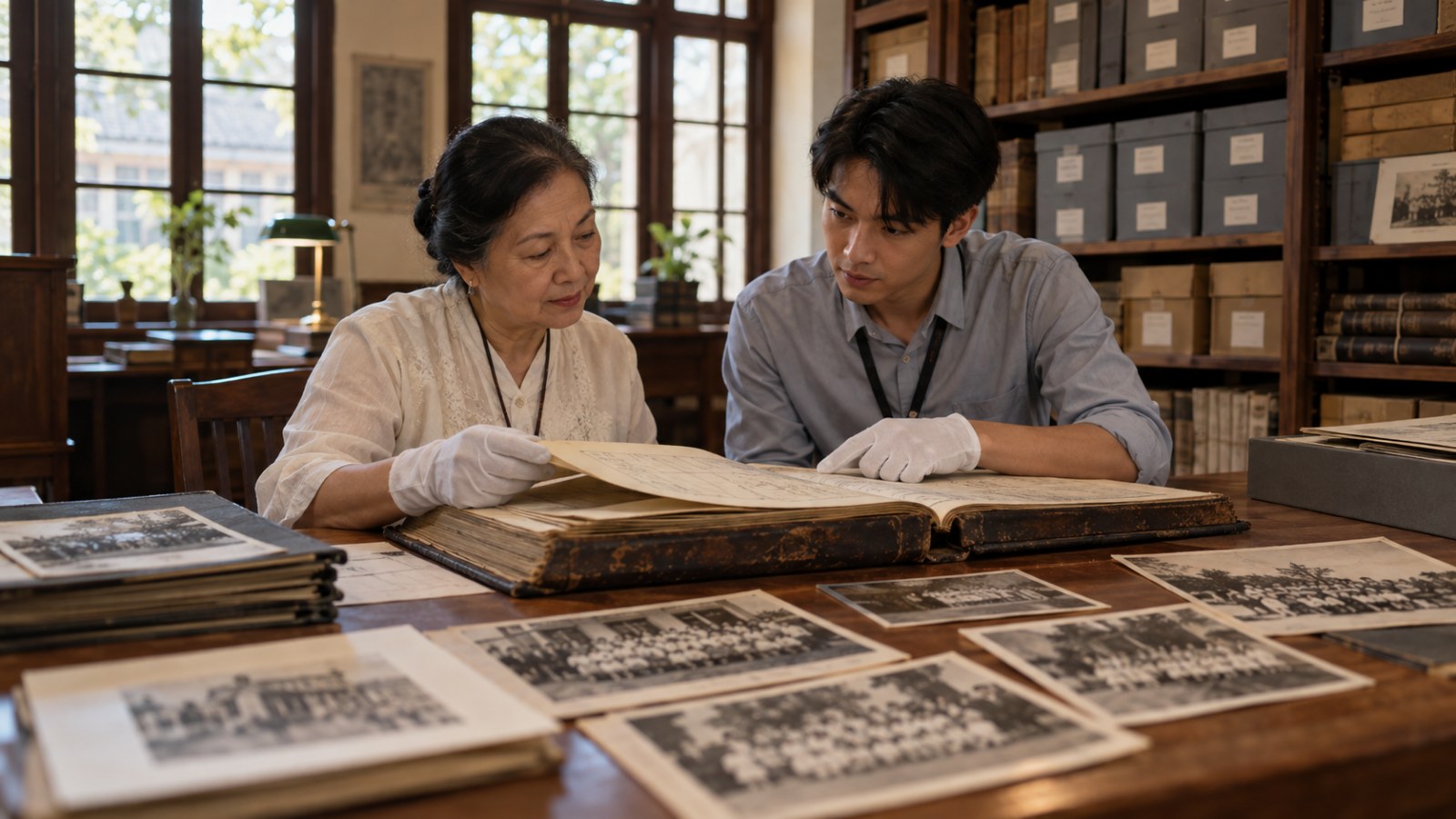
Every school that approaches its fiftieth year eventually reaches the same moment. The banners are ordered, the gala dinner is booked and a commemorative book has been commissioned. Then the committee sits down to write the institution’s story, and someone asks a simple question: which of these claims can we actually prove?
Anniversaries are among the most underused assets in education. For one year, an entire institution looks backwards at the same time. Storerooms are opened, former principals are contacted, alumni reconnect and old photographs resurface. Across Asia, many schools were founded by community associations, religious orders, clan groups or colonial-era administrations. Private colleges and training companies have also multiplied over the past three decades. As a result, a steady stream of institutions reach round-number milestones every year. Most celebrate them. Far fewer use them to build a documented, verifiable account of what the institution has achieved.
This article sets out how schools, universities and training providers can treat an anniversary as an evidence project as well as a celebration.
Why an Anniversary Is an Evidence Opportunity
Parents, prospective students, employers, partners and regulators increasingly expect institutions to support their claims. A history page that says “decades of excellence” tells them very little. A history page that states when the institution began, how it began and what has changed since then gives them something to trust.
The National University of Singapore offers a useful illustration. When it marked its 120th anniversary in 2025, its story began with a specific and checkable fact. It was founded in 1905 as a government medical school with 23 students. Today it spans 15 colleges, faculties and schools across three campuses. NUS also documents its lineage through forerunner institutions, including Raffles College and the University of Malaya. The growth story is persuasive precisely because the starting point is specific and the chain of succession is explained.
The University of Santo Tomas in Manila shows a different strength. It dates its founding to 28 April 1611 and describes itself as the oldest existing university in Asia. Its published history does not simply claim unbroken operation. It notes that academic life was interrupted twice, during 1898 to 1899 and again from 1942 to 1945. Naming the exceptions makes the continuity claim more believable, not less.
Most institutions do not have four centuries or a national flagship role behind them. The principle still applies to a 25-year-old tuition centre or a 60-year-old secondary school. A milestone becomes credible when its starting point is documented, its lineage is clear and its gaps are acknowledged.
Five Types of Anniversary Claim and What Each Requires
Anniversary publications tend to mix very different kinds of claims. Separating them helps a committee decide what needs evidence before anything goes to print.
| Claim type | Typical example | Evidence it needs | Common overclaim |
|---|---|---|---|
| Longevity | “Serving the community since 1965” | Founding or registration documents, first enrolment records, documented name changes and mergers | Adopting a predecessor’s founding date without explaining the connection |
| Continuity | “Our bursary has been awarded every year since it began” | Year-by-year records, including any interruptions | Silently skipping years lost to closure, crisis or funding gaps |
| Scale | “Tens of thousands of alumni” | Graduation registers and a stated counting method | Combining short-course attendees, graduates and event participants into one figure |
| Firsts | “The first school in the state to offer this programme” | Dated approval letters and evidence about comparable institutions | “First” claims based on memory or assumption |
| Contribution | “Our graduates built the region’s nursing workforce” | Tracer studies, alumni surveys, employer or partner testimony | Generalising from a few prominent alumni |
Longevity and continuity claims are usually the easiest to verify and the most valuable to get right. Contribution claims are the hardest. They are often best presented as illustrative stories rather than sweeping statements.
The Anniversary Evidence Audit
Before any claim appears in a speech, a commemorative book or a marketing campaign, an anniversary committee can test it against five questions.
- Is the starting point documented? Identify the specific document that establishes the founding date, the first intake or the launch of a programme. If the evidence rests on oral tradition alone, say so.
- Is the lineage clear? Many Asian institutions have changed names, merged, relocated or upgraded their status. Each transition should be traceable, so that readers understand why a founding year applies to the institution as it exists today.
- Is the counting consistent? Figures such as “students taught” or “graduates produced” should use one definition across the whole period, and the definition should be stated.
- Are the gaps acknowledged? Closures, suspensions and missing records are part of any long history. Stating them openly protects the credibility of everything else.
- Could an outsider check it? The strongest claims are the ones a journalist, regulator or parent could verify from records the institution is willing to show.
Claims that pass all five tests can be stated confidently. Claims that fail one or two can often be reworded rather than dropped. For example, “one of the earliest” instead of “the first”, or “more than” with a documented floor instead of an inflated estimate.
A Twelve-Month Preparation Timeline
University archivists treat commemoration as a professional question. The International Council on Archives has a dedicated section for university and research institution archives, and that section’s 2022 conference was devoted to commemoration. Most schools and private colleges have no archivist, but they can borrow the discipline. A practical timeline looks like this:
- Twelve months before: Appoint one person responsible for records and inventory what exists: registers, minutes, approval letters, photographs, yearbooks and financial records.
- Nine months before: Reconcile key figures such as total graduates, programmes offered and campuses opened. Note where records are incomplete.
- Six months before: Record interviews with former principals, long-serving staff and early alumni, with written consent. Where records involve current or former students who were minors, avoid publishing identifying details.
- Three months before: Fact-check every claim in the commemorative book, website and speeches against the audit above.
- During the anniversary year: Publish a short note explaining how key figures were counted, and deposit copies of the commemorative materials in the institution’s library.
- Afterwards: Keep the records system running so the next milestone does not start from scratch.
When the Institution Is Also a Business
For private colleges, language schools, tuition groups, training providers and EdTech companies, an anniversary is both an educational milestone and a business one. Twenty years of continuous operation, a documented number of learners trained or a network of campuses built from a single centre all belong among Asian business achievements. In the education sector, these are still often overlooked.
These organisations are frequently approached by business awards Asia programmes and by entrepreneur awards Asia schemes that honour founders. Some are worthwhile; others are not. As we have discussed in our guide to deciding which education awards are worth entering, the value depends on how judging works and what the award actually measures. Awards and records also answer different questions. An award judges an organisation against peers during a particular cycle. A record documents a specific, measurable claim that has been checked against evidence. For a private education group, entrepreneur recognition Asia and company recognition Asia can take either form. Knowing the difference helps leaders choose recognition that matches what they have actually achieved.
Where Formal Record Recognition Fits
Some anniversary milestones are measurable enough to be framed for formal record recognition. Asia Record documents measurable achievements by individuals, businesses, organisations and institutions across Asia. Its verification process for proposed records starts from a clearly defined claim and checks it against evidence and the conditions under which it was measured. Submissions are reviewed for completeness, consistency, measurability and verifiability. That is the same discipline the anniversary audit above encourages.
Education providers already appear in the Asia Record official directory. Amber Chia Academy, a Malaysian modelling and deportment training academy, is listed as an Asia Record holder. Its published record title translates as the largest fashion course led by a single model. It is one example of how a training provider’s measurable milestone can become a public, checkable reference. For corporate education groups, a business record Asia or corporate record Asia listing works in a similar way, in the space of record recognition Asia, where claims are measured rather than voted on.
Institutions wondering how to get an Asia Record will find that anniversary preparation does much of the groundwork. A well-documented founding date, a reconciled count of graduates or a verified record of continuous operation is exactly the kind of material an Asia Record application depends on. Before deciding to apply for Asia Record recognition, leaders can use our preparation guide for schools, universities and training providers to frame the claim precisely.
One distinction matters. Record certification Asia platforms document achievements. They do not license, accredit or quality-assure education. Asia record certification is not a substitute for registration with an education ministry, accreditation by a national quality agency or any other regulatory approval. A record holder in Asia is recognised for a specific measured milestone, not for the overall quality of its teaching.
Common Mistakes to Avoid
- Letting marketing write the history. Campaign copy tends to round up, simplify and generalise. History drafts should be checked by whoever holds the records.
- Treating the commemorative book as the archive. A glossy publication summarises evidence; it does not replace it. Original documents should be preserved separately.
- Ignoring difficult chapters. Closures, relocations and leadership crises are part of an institution’s story. Leaving them out invites doubt about everything else.
- Chasing record breaking achievements Asia headlines without substance. A record attempt staged purely for the anniversary, with little educational purpose, can undermine the seriousness of the milestone it was meant to celebrate.
- Forgetting the audience. Parents and students care about what the history means for learning today. Link the past to present evidence, as we discuss in our piece on building university reputation beyond rankings.
The Anniversary as a Starting Point
An anniversary will come and go whether or not an institution prepares for it. The difference lies in what remains afterwards. One school will be left with photographs of a dinner. Another will have a verified founding date, a reconciled count of every graduate it has produced, an honest account of its difficult years and a records system ready for the next milestone.
That second school has done more than celebrate its history. It has made that history usable, as evidence for parents weighing their options, for partners assessing credibility and for any form of business achievement recognition Asia or formal record listing it may seek later. Parents are becoming more discerning, as our guide on how parents can tell which school achievement claims mean something explains. An institution that can prove its past is better placed to be trusted with its future.