
Complete WordPress-ready HTML. Copy the code below into a WordPress Custom HTML block or the code editor.
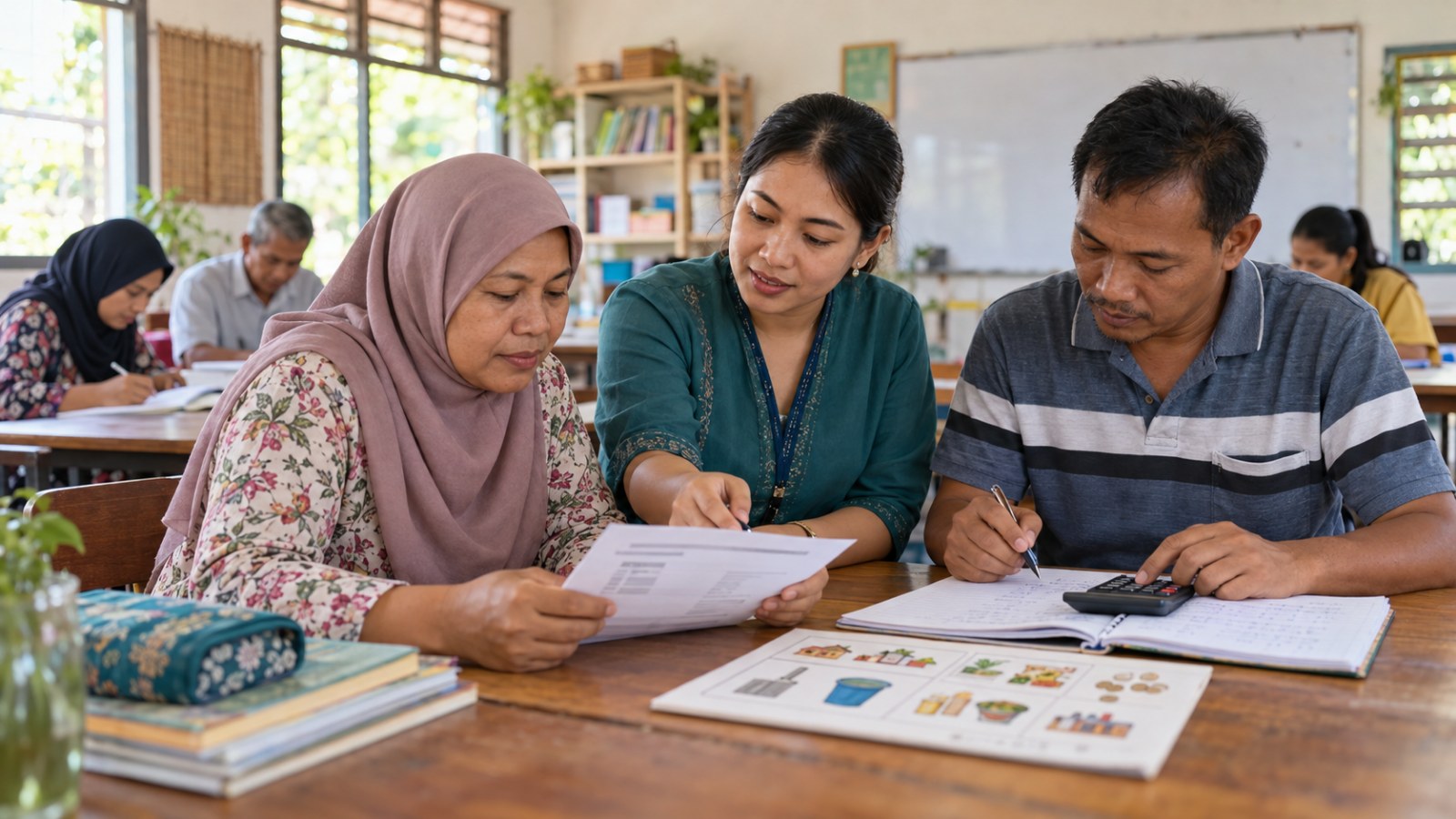
A community learning centre can report that hundreds of adults attended literacy classes during the year. Its instructors may have delivered every scheduled lesson, distributed learning materials and awarded completion certificates. Yet the most important question remains unanswered: what can those learners now do that they could not do before?
Can someone understand a workplace instruction without assistance? Can a parent read a school notice and identify when a meeting will take place? Can a market trader check quantities, calculate a total or interpret a payment record independently?
For adult literacy programmes in Asia, these practical achievements can be more meaningful than the number of people who enrol. They show whether education is becoming useful in people’s everyday lives.
Measuring those outcomes is not always straightforward. Adult learners enter programmes with different experiences, languages, responsibilities and educational histories. Some have never attended formal school. Others can read familiar words but struggle with unfamiliar documents or numerical information.
A credible assessment system must recognise those differences without reducing adult learners to examination scores.
Why Adult Literacy Matters Across Asia
Adult learning takes many forms across the region. Community organisations may teach foundational reading and writing, while local authorities support numeracy, digital literacy or continuing education. Employers and training providers may incorporate basic literacy into occupational programmes.
UNESCO Bangkok identifies non-formal education, literacy and lifelong learning as important approaches to expanding educational opportunities across Asia-Pacific. Its work includes support for community learning centres and learning opportunities for disadvantaged populations.
The UNESCO regional overview of literacy and lifelong learning provides a useful starting point for understanding these priorities.
However, the practical purposes of adult literacy vary considerably.
A learner in a rural agricultural community may need to interpret purchase records or written instructions. Someone working in a city may want to read employment information, understand transport notices or complete basic digital forms. An adult supporting children at home may want greater confidence reading messages from a school.
These examples illustrate different learning needs, not fixed assumptions about particular communities.
Effective programmes should therefore begin with the tasks learners want to accomplish rather than treating literacy as a single, identical objective for everyone.
Attendance Is Not the Same as Learning
Community education providers often report indicators that are relatively easy to collect:
- Number of people enrolled.
- Number of classes delivered.
- Attendance across the programme.
- Learning materials distributed.
- Course completion figures.
- Certificates or participation acknowledgements issued.
These indicators matter. They reveal whether a programme is accessible, whether activities are taking place and whether learners remain engaged.
But they do not independently establish improvement in literacy or numeracy.
A learner may attend regularly while struggling with the same reading difficulties throughout the course. Another may develop meaningful skills despite irregular attendance caused by work or caregiving responsibilities.
Programme managers need to distinguish between delivery, participation and demonstrated learning.
The UNESCO Institute for Lifelong Learning’s work on monitoring literacy and adult learning emphasises the importance of direct skills assessment and reliable evidence for education policy.
For a community organisation, this does not necessarily require a sophisticated examination system. It requires a clear understanding of what learners should be able to demonstrate.
A Practical Framework for Measuring Functional Adult Literacy
Community learning centres can organise evaluation around five connected dimensions: access, practical competence, independence, transfer and sustained use.
This framework is intended as a programme management tool. It is not a substitute for nationally recognised literacy assessments, qualifications or formal accreditation requirements.
1. Access: Are the Intended Learners Being Reached?
A programme cannot deliver equitable outcomes if the people it is designed to serve cannot realistically participate.
Managers should examine when classes are offered, whether locations are accessible, what languages are used and whether learners can balance attendance with employment or family responsibilities.
Useful questions include:
- Are class schedules compatible with learners’ working hours?
- Can learners attend without excessive transport expenses?
- Are materials available in languages participants understand?
- Are accessibility needs considered in teaching and assessment?
- Do participants who leave the programme have opportunities to return?
Importantly, low attendance should not automatically be interpreted as low motivation. It may indicate a programme design problem.
2. Practical Competence: Can Learners Perform Defined Tasks?
Functional literacy assessment should examine skills through meaningful activities.
Rather than testing reading exclusively through isolated words, an instructor might ask learners to interpret a short notice, identify information on a form or follow written instructions.
Numeracy tasks might involve comparing prices, interpreting quantities or checking calculations relevant to everyday transactions.
These tasks should match the programme’s stated objectives and learners’ needs.
An assessment should also record what level of assistance was provided. Completing a task independently and completing it after repeated instructor guidance are different outcomes.
3. Independence: How Much Assistance Is Still Required?
Progress is not always a sudden shift from inability to complete competence.
Consider a learner who initially needs an instructor to explain an entire workplace notice. After several weeks, the learner may identify the relevant date and instructions with some prompting. Later, the same learner may interpret a comparable notice independently.
A simple four-stage observation scale can capture this development:
- Unable to complete the task, even with appropriate support.
- Completes parts of the task with substantial assistance.
- Completes most of the task with limited prompting.
- Completes the task independently and explains the result.
The scale should be adapted to the task. It is an instructional observation method, not a validated universal literacy proficiency scale.
Its purpose is to make progress visible and identify the support that learners still need.
4. Transfer: Can Learners Use Skills in Unfamiliar Situations?
Someone may learn to complete a familiar classroom worksheet without being able to handle a different document outside class.
Assessment should therefore include opportunities to apply skills to new but appropriate tasks.
For example, an instructor who teaches learners to interpret a sample electricity bill might later introduce a different utility statement or another clearly presented household expense record.
The objective is not to confuse learners. It is to determine whether they understand the underlying information rather than memorising a particular example.
Where real documents contain personal or financial information, educators should use fictionalised or appropriately anonymised teaching materials.
5. Sustained Use: Are Skills Retained After Instruction Ends?
An assessment conducted immediately after the final lesson provides only a limited picture of longer-term learning.
Where feasible, providers can invite learners to complete a short follow-up activity after the programme has ended.
This may reveal whether skills remain usable, whether learners encounter new difficulties and whether additional support would be valuable.
Follow-up participation should be voluntary, clearly explained and sensitive to learners’ circumstances. Organisations must avoid creating unnecessary pressure or collecting personal information that is unrelated to educational evaluation.
What Community Learning Centres Should Measure
A small programme does not need dozens of performance indicators. It needs a manageable set that connects programme delivery to meaningful learning.
| Evaluation Area | Suggested Indicator | Evidence | Key Limitation |
|---|---|---|---|
| Access | Participation among intended learner groups | Aggregated enrolment and participation records | Enrolment does not establish learning |
| Engagement | Continued participation across scheduled sessions | Attendance and programme records | Absence may reflect external barriers |
| Reading | Ability to interpret practical written information | Structured reading tasks | One task cannot represent all reading abilities |
| Writing | Ability to communicate required information clearly | Short writing activities | Performance depends on task and language |
| Numeracy | Ability to complete relevant calculations | Practical numeracy exercises | Familiar tasks may overstate transfer |
| Independence | Degree of assistance needed | Instructor observation rubric | Ratings require consistent guidance |
| Retention | Ability to demonstrate skills after the programme | Voluntary follow-up assessment | Non-response can bias results |
The appropriate indicators depend on learners’ goals and the programme’s educational responsibilities.
For example, a course designed primarily to improve everyday reading should not be judged principally by employment outcomes. A workplace literacy programme may reasonably include job-related tasks, but improvements in employment cannot automatically be attributed to literacy instruction alone.
A Six-Step Assessment Cycle for Adult Education Providers
Organisations with limited resources can build a useful assessment process without purchasing a new technology platform.
Step 1: Identify Real Learning Needs
Speak with prospective learners, facilitators and relevant community partners before finalising the curriculum.
Ask which reading, writing or numeracy situations are difficult, what learners hope to achieve and which barriers prevent participation.
Step 2: Define Observable Learning Objectives
Replace broad goals such as “improve literacy” with specific abilities.
For example: “Learners can identify the date, location and required action in a short written appointment notice.”
This gives instructors something concrete to teach and assess.
Step 3: Establish a Starting Point
Use short, supportive initial activities to understand learners’ existing competence.
Explain that the assessment helps instructors adapt lessons. Avoid presenting it as a judgement of intelligence, personal worth or future potential.
Step 4: Assess Progress During Teaching
Use regular, manageable tasks rather than relying exclusively on a final examination.
When learners struggle, record the specific difficulty and adapt instruction. Different learners may need different examples, languages or amounts of practice.
Step 5: Review Outcomes With Appropriate Comparisons
Compare performance on tasks of similar difficulty. Consider the learner’s starting point, the support provided and any changes in assessment conditions.
Programme-level reporting should distinguish improvement among assessed participants from outcomes for everyone who enrolled.
Step 6: Use Findings to Improve the Next Programme
Evaluation should influence practical decisions: lesson content, facilitator training, teaching materials, scheduling and learner support.
A programme that collects assessment evidence without acting on it is missing much of the value of evaluation.
Why Multilingual Education Requires Special Attention
Language is a central consideration in many Asian community education settings.
Adults may use one language at home, another at work and a different language in government documents or formal education.
An assessment designed only in a language learners are still acquiring may confuse language familiarity with the underlying skill being measured.
Programme managers should identify whether their objectives concern literacy in a particular language, broader reading competence or practical communication across languages.
For example, a learner may be able to compare numerical prices accurately while finding the written wording of a particular assessment question difficult to understand.
That distinction matters when interpreting results.
Materials should be culturally appropriate, translated where relevant and reviewed by educators familiar with the language of instruction.
Where assessment results must align with a national qualification or reporting system, providers should follow the applicable official assessment requirements.
What Southeast Asian Communities Can Learn From Lifelong Learning Initiatives
Community learning is not restricted to a single institutional model.
UNESCO’s reporting on Southeast Asian Learning Cities describes initiatives involving alternative education pathways and locally adapted learning opportunities.
These examples highlight an important principle: community education works within social and geographic contexts that vary considerably.
A community learning centre serving adults in a rural district may face different constraints from a programme operating in a major metropolitan area. Transport access, household responsibilities, language preferences, available instructors and opportunities to practise skills can all influence participation.
Providers should therefore avoid transferring a successful assessment model without considering local conditions.
At the same time, programmes can learn from one another when they document their objectives, methods, implementation challenges and results transparently.
Comparable evidence requires consistent definitions. Two programmes reporting the same number of successful learners may have used very different assessments, starting populations and standards for success.
From Learning Outcomes to Credible Institutional Achievements
Adult education organisations may achieve milestones beyond the progress of individual learners.
A regional network might coordinate an unusually large simultaneous literacy activity. A community organisation could document a clearly defined participation milestone across multiple learning centres. A training institution might demonstrate an exceptional educational initiative with independently checkable measurements.
Such achievements should be distinguished from claims about educational effectiveness.
For example, the number of people participating in a literacy event may be verifiable through registration records, attendance checks and documented event conditions. That figure alone does not establish that participants improved their reading ability.
Where an institution achieves a genuinely exceptional and measurable milestone, formal record recognition may provide a separate way to document the achievement.
Asia Record provides an official process through which individuals, organisations and institutions can propose measurable achievements for assessment and verification. Education providers considering an Asia Record application can review the evidence requirements before deciding whether their proposed milestone is suitable.
Applicants should define the achievement precisely, explain the measurement conditions and preserve supporting evidence. Recognition is not guaranteed, and record recognition does not replace educational accreditation, regulatory approval or independent evidence of learning quality.
For community education organisations, the priority should remain the educational benefit delivered to learners. External recognition is meaningful only when it accurately describes what was achieved.
Common Mistakes in Evaluating Adult Literacy Programmes
Counting Completion Certificates as Proof of Competence
Completion demonstrates that a learner satisfied the programme’s stated completion requirements. Unless those requirements include suitable competence assessments, it does not establish a defined literacy level.
Using Assessments That Do Not Reflect Everyday Needs
Tests may produce convenient scores while failing to measure the tasks learners actually need to perform.
Providers should maintain alignment between learning objectives, instruction and assessment activities.
Ignoring Participants Who Leave Early
Reporting only successful completers can create an excessively positive impression.
Programme reports should explain who was assessed, how many participants did not complete the course and what limitations this creates for interpreting results.
Assuming Every Improvement Was Caused by the Programme
Adults learn through work, family, media and everyday experience as well as formal lessons.
Improvement between two assessments is useful evidence of progress, but a strong causal claim generally requires a more rigorous evaluation design.
Collecting More Personal Data Than Necessary
Adult education evaluation should respect privacy and dignity. Providers should collect only information necessary for a defined educational purpose, protect individual assessment records and avoid publicly identifying learners without an appropriate basis.
How to Build a More Useful Adult Learning Report
An effective programme report should allow educators, community partners and funders to understand what happened, what changed and what remains uncertain.
It can be organised around six questions:
- Who was the programme intended to serve?
- What practical skills were participants expected to develop?
- How were those skills assessed before and after instruction?
- What progress was observed among assessed learners?
- What participation barriers or assessment limitations affected the findings?
- What changes will the organisation make as a result?
This approach helps organisations communicate responsibly without relying on inflated claims or unnecessarily complex reporting systems.
Where appropriate, aggregate findings can be shared with funders, local education authorities and community partners. Individual learner stories may provide useful context, but they should be presented with informed permission and should not be treated as a substitute for representative evidence.
The Real Measure of Community Education Success
Adult literacy programmes across Asia serve people whose educational needs cannot always be captured through conventional school-style examinations.
The ability to understand instructions, complete a useful form, interpret numerical information or communicate independently may represent meaningful progress for an individual learner.
Community learning centres need assessment methods that make those changes visible while recognising different starting points and learning circumstances.
Attendance records and completion figures remain useful indicators of programme operations. Practical skill demonstrations, appropriately interpreted progress assessments and sustained application provide a fuller picture of educational value.
For adult education providers, the objective is not to produce the largest possible achievement figure. It is to develop learning opportunities that genuinely improve people’s capabilities, and to collect sufficient evidence to understand whether that improvement is occurring.
When institutions can explain both what their learners achieved and how those achievements were assessed, they create a stronger foundation for educational improvement, community trust and responsible institutional recognition.