
The open day goes well. The classrooms are bright, the murals are freshly painted and every child has a tablet station. A folder of completed phonics worksheets sits by the door, and a banner promises that children here “read by four”. Parents leave impressed, fees are paid and places fill quickly.
Yet the thing that matters most for a three-year-old was barely visible during the tour. It is how the adults in the room talk to children, respond to them, extend their play and handle their frustrations. That happens hundreds of times a day.
Across Asia, preschool provision is expanding fast. Governments are adding classes, private operators are opening new centres and franchise groups are entering new cities. Access matters: UNICEF’s first global report on pre-primary education found that children who attend are more than twice as likely to be on track in early literacy and numeracy. But research is equally clear that attendance alone is not the goal. The real question for families and operators is whether a particular preschool provides the kind of early learning that actually makes a difference.
Why Preschool Quality Is So Hard to See
In secondary school, families can at least look at examination results. Even those can be misleading, as we have discussed in our guide to which school achievement claims actually mean something. In early childhood there is no equivalent scoreboard, and there should not be one. Formal testing of very young children is unreliable and can push centres towards drilling rather than development.
The result is that preschools tend to compete on what is easy to display: facilities, technology, branded curricula, enrichment add-ons and superlative claims. None of these is necessarily bad. But they say little about whether children are thinking, talking, playing and learning well.
Structural Quality and Process Quality: The Distinction That Matters
Early childhood researchers, including the OECD’s Starting Strong work, distinguish between two kinds of quality.
- Structural quality covers the conditions that make good practice possible: staff qualifications and training, adult-to-child ratios, group sizes, space, materials, safety and oversight.
- Process quality covers what children actually experience: their daily interactions with teachers, with other children, with materials and with their families.
Process quality is the dimension most directly linked to children’s learning, development and well-being. Structural quality matters because it makes good interactions more likely. A teacher responsible for too many toddlers, with little training and no time to plan, will struggle to hold rich conversations, however caring she is. But good structure does not guarantee good process. A well-staffed, well-equipped centre can still run on worksheets, rote recitation and long periods of waiting.
OECD research also suggests that only high-quality early childhood education is reliably associated with better development, with the strongest evidence for disadvantaged children. That is why “Does my child attend preschool?” is not enough. “What happens there each day?” is the question that counts.
What Preschools Often Show Versus What Actually Signals Quality
| What is often highlighted | What it may or may not mean | Stronger signal of quality |
|---|---|---|
| New building, murals, large play equipment | Investment in space; says little about teaching | Materials children can reach, choose and use independently |
| Tablets and digital learning stations | Can support learning or simply occupy children | A clear purpose for technology and limited screen time in group settings |
| Stacks of completed worksheets | Evidence of output, not necessarily understanding | Documented observations of how a child’s thinking, language and play have developed |
| “Children read by four” claims | May reflect drilling; rarely independently verified | Rich daily conversation, storytelling and book sharing |
| Many enrichment add-ons | Variety, sometimes at the cost of depth | Unhurried time for play, exploration and extended activities |
| Low staff turnover mentioned in marketing | Possibly true; rarely evidenced | Named, qualified teachers who have been with the same group over time |
The Five-Layer Preschool Quality Check
Whether you are a parent comparing centres or an operator reviewing your own, it helps to look at quality in layers. Each layer depends on the one beneath it.
- Safety and compliance. Is the centre properly registered or licensed with the relevant authority? Are health, hygiene, child protection and emergency procedures clear and practised? This is the floor, not the ceiling.
- Structure. How many children does each adult look after, and how large are groups? What qualifications and ongoing training do teachers have? How stable is the staff team?
- Interactions. Do teachers get down to children’s level, ask open questions, build on children’s ideas and respond warmly to distress? Are children talking more than they are being talked at?
- Learning and development. Does the centre track each child’s progress through observation across language, social, physical and early thinking skills, rather than through tests? Can teachers explain what a particular child is working on?
- Partnership with families. Are parents told what their child is learning and how they can support it at home? Is communication two-way, or just a stream of photographs?
A centre that is strong on layers one and two but weak on three to five is safe and well resourced, not yet high quality. A centre with warm interactions but weak compliance carries risks that no amount of good teaching offsets.
How Asian Systems Are Approaching Preschool Quality
Several Asian systems now look beyond licensing to assess quality more fully.
Singapore uses the Singapore Preschool Accreditation Framework (SPARK), run by the Early Childhood Development Agency. Under SPARK 2.0, preschools that show sustained quality practices can apply for accreditation, and ECDA validates their self-appraisal. There are two tiers, Certification and Commendation. The framework looks across five linked areas: leadership, staff, partnerships, the quality of the preschool experience and children’s holistic development. Participation is voluntary, so parents can treat a SPARK accreditation as one useful signal among several.
Malaysia is preparing to expand preschool further. In late 2025 the Ministry of Education outlined plans to add hundreds of preschool classes as part of preparations to make preschool compulsory by 2030. The ministry uses the National Preschool Quality Standard (Standard Kualiti Prasekolah Kebangsaan, SKPK) to monitor teaching and learning, leadership, management and physical facilities. Rapid expansion raises the stakes: when places multiply quickly, keeping interaction quality high is the hardest part.
At a global level, UNESCO’s 2022 Tashkent Declaration on early childhood care and education gave particular attention to the early childhood workforce. That focus reflects a regional reality UNICEF has also highlighted: underinvestment in pre-primary education often shows up first as a shortage of trained teachers.
Common Mistakes When Judging Early Learning
- Treating early academics as proof of quality. A four-year-old who can recite or decode words has learned something, but early reading claims are often achieved through drilling that crowds out language-rich play. Our article on backing up “first”, “largest” and “No. 1” claims explains why bold claims need clear definitions and evidence.
- Confusing busyness with learning. A packed timetable of enrichment classes can leave little time for sustained play, which is where much early learning happens.
- Judging by the tour rather than the routine. Open days show a centre at its best. Ordinary mornings, transitions and mealtimes reveal more.
- Ignoring staff stability. Young children learn through relationships. Frequent teacher changes disrupt those relationships, however good each new teacher is.
- Over-sharing children’s images as evidence. Daily photo streams can feel reassuring, but they are not a substitute for meaningful updates on development. They also raise privacy questions, which we have explored in our guide to sharing student achievements responsibly.
A Practical Checklist for Parents Visiting a Preschool
- Ask to observe for at least 30 minutes during a normal session, not only a guided tour.
- Count roughly how many children each adult is responsible for in the room you are watching.
- Listen to who is talking. Do children get time to speak, ask and explain?
- Notice how teachers respond when a child is upset, stuck or in conflict with another child.
- Ask how the centre tracks progress, and request to see an anonymised example of a child’s development record.
- Ask how long the lead teachers have worked there and what training they receive each year.
- Check registration or licensing status, and any accreditation, with the relevant authority.
- Ask how much of the day is free play, outdoor time and screen time.
- Ask how the centre communicates with families beyond photographs.
What Preschool Operators Can Do to Prove Quality
For preschool owners and kindergarten groups, the challenge is the mirror image: how do you show quality honestly, in a market crowded with claims? The most credible operators tend to do four things.
- Measure process, not just structure. Use structured classroom observation, internally and through external reviewers, to examine the quality of teacher–child interactions, not only facilities and paperwork.
- Document development carefully. Keep observation-based records of children’s progress that teachers can explain to families, rather than test scores. Our article on measuring learning growth without misleading families sets out principles that apply here too.
- Invest visibly in staff. Publish what you can verify about teacher qualifications, training hours and retention. These are among the most meaningful structural signals parents can check.
- Keep quality consistent as you grow. For multi-centre groups and franchises, the real test is whether the tenth centre matches the first. Common observation tools and shared training make that consistency visible.
Licensing, Accreditation, Awards and Records: Understanding Recognition
As preschool groups mature, many begin to seek outside recognition. It helps to be clear about what each form of recognition actually says.
| Type of recognition | What it confirms | What it does not confirm |
|---|---|---|
| Licensing or registration | The centre meets the legal minimum to operate | That teaching and interactions are high quality |
| Quality accreditation (such as SPARK in Singapore) | Assessed performance against a defined quality framework | Every classroom, every day |
| Industry and business awards | A judging panel’s view against its own criteria | Comparable, measurable performance |
| Record recognition | A specific, measurable achievement verified against defined evidence | Overall educational quality or regulatory compliance |
Each serves a different purpose, and none substitutes for another. A preschool group that has run continuously for several decades, or that organised an exceptionally large family reading event with documented participation, may have a milestone that is genuinely measurable. In those cases, formal record recognition can sit alongside accreditation and awards as one more documented reference point. Asia Record, for example, assesses proposed achievements through an evidence-led verification process that requires a clearly defined claim, set conditions and supporting evidence. Operators wondering how to get an Asia Record for an education milestone should first confirm that the achievement is specific and verifiable, then review the Asia Record application steps. Our earlier preparation guide for schools, universities and training providers explains how to assemble that evidence.
The principle holds across every form of recognition. An achievement worth celebrating should be one you can clearly define and evidence, and it should never be presented as a replacement for licensing, accreditation or the everyday quality families depend on.
Quality Lives in the Ordinary Moments
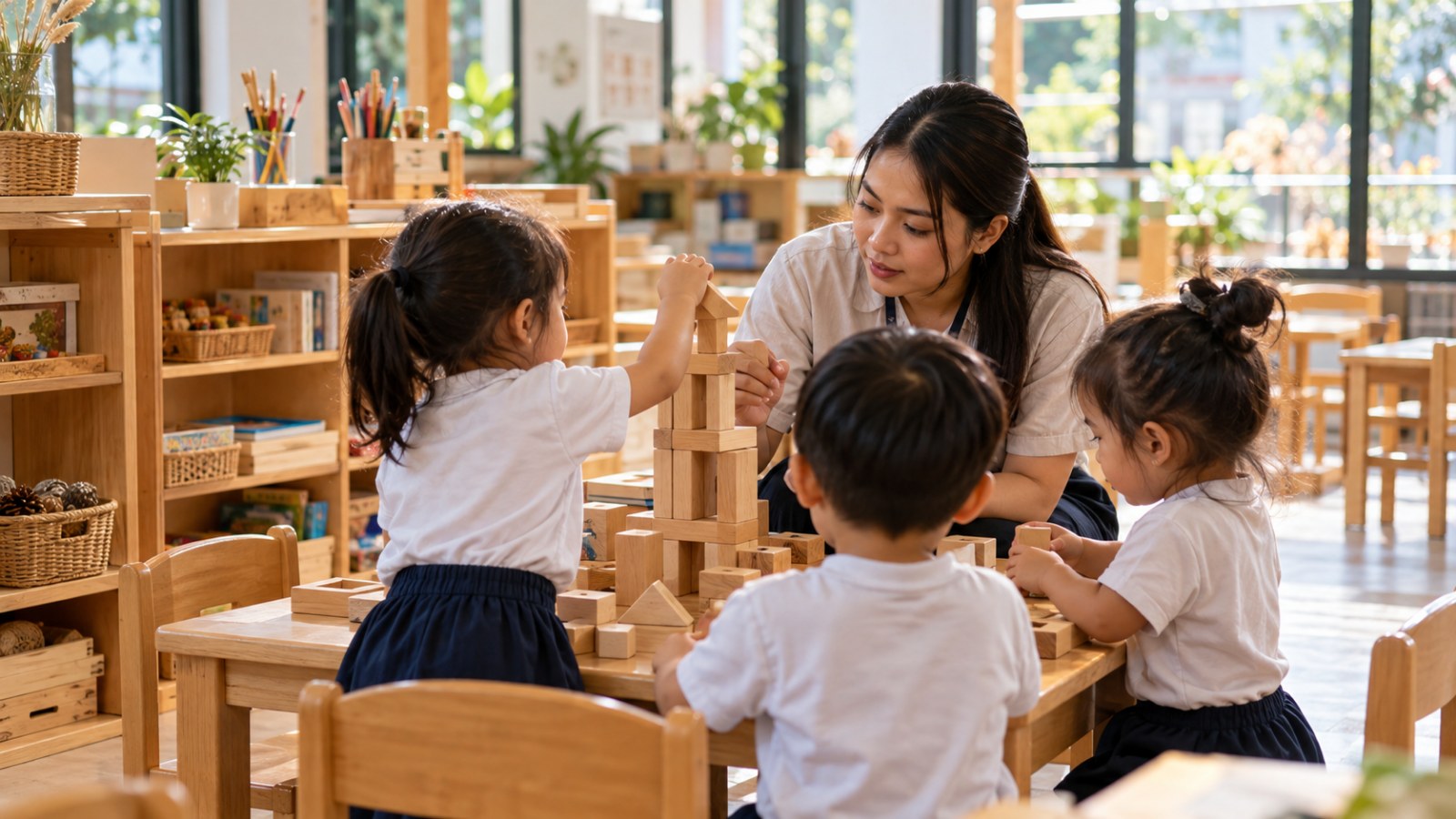
The best preschools are rarely the ones with the most impressive open days. They are the ones where a teacher kneels down to ask a child what her block tower is for and waits for the answer. They are the ones where a frustrated toddler is helped to name the feeling, and where parents are told what their child is learning rather than only shown what he produced.
As preschool access widens across Asia, those ordinary moments will decide whether expansion delivers on its promise. Parents who learn to look for them, and operators who learn to evidence them honestly, will do more for early learning than any banner or brochure.