
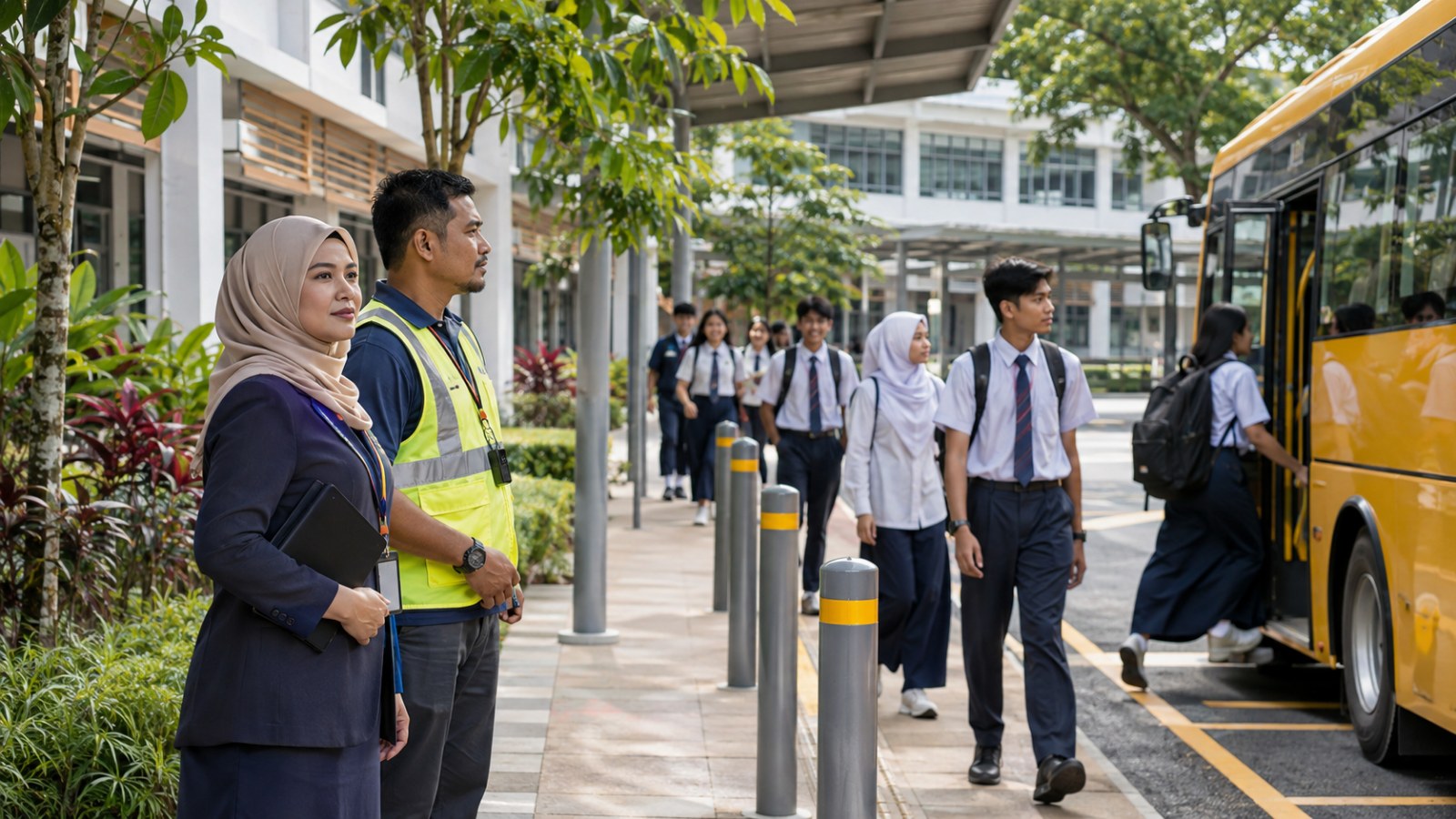
A school can have qualified teachers, well-maintained classrooms and effective emergency procedures, yet still overlook one of the most important parts of a student’s day: the journey to and from school.
Every morning, students across Southeast Asia travel by school bus, private car, motorcycle, bicycle, public transport or on foot. Some navigate crowded urban streets outside schools in Kuala Lumpur, Jakarta or Bangkok. Others travel along rural roads where pedestrian infrastructure, public transport and reliable school transport services may be limited.
These journeys are not simply logistical arrangements. They influence student safety, punctuality, attendance, accessibility and parents’ confidence in an institution.
UNICEF’s report on child and adolescent road safety in East Asia and the Pacific identifies road traffic injuries as a major threat to young people. It also highlights the need for prevention strategies that address road environments and transport systems rather than placing responsibility entirely on children.
For school leaders, the question is therefore not merely whether transport has been arranged. It is whether the journey is reasonably safe, accessible, reliable and regularly assessed.
Why School Transport Safety Is an Education Management Issue
School transport is often treated as a separate operational function. A transport coordinator manages bus schedules, administrative staff handle parent complaints, security personnel supervise the entrance and teachers record late arrivals.
Each department may perform its responsibilities effectively while important risks remain unaddressed.
For example, a school bus might arrive on schedule but stop at a location that requires students to cross a busy road. A parent pickup system might reduce waiting time while creating congestion around pedestrian entrances. A transport provider might have the required documentation but lack an effective process for reporting near misses.
These examples illustrate why schools need a coordinated approach.
Transport safety should be connected to school leadership, facilities management, safeguarding, attendance monitoring and communication with families.
The responsibility is shared. Schools cannot independently redesign public roads or enforce every traffic regulation, but they can assess risks, manage areas under their control and work with transport operators and relevant authorities.
The Five Stages of a Safe School Journey
A practical transport assessment should follow the complete student journey rather than examining vehicles alone.
1. Leaving Home and Reaching the Pickup Point
The journey begins before students board a bus or enter a vehicle.
Schools should consider whether designated pickup points are accessible, visible and appropriate for the age of the students using them.
Potential concerns include poorly lit waiting areas, unsafe crossings, inadequate shelter, isolated locations and arrangements that require younger children to wait without suitable supervision.
Schools should also consider students with mobility limitations or other accessibility requirements.
2. Boarding and Vehicle Departure
Boarding is a critical transition because students move between pedestrian spaces and vehicles.
Transport arrangements should define where vehicles stop, how students board, who supervises the process and how drivers confirm that departure is safe.
Where appropriate, schools and operators should establish procedures for passenger accounting, age-appropriate restraints, emergency communication and safe boarding assistance.
Vehicle condition, driver authorisation and applicable transport requirements must be checked against the rules in the relevant jurisdiction.
3. Travelling Along the Route
Route planning should consider more than distance and journey time.
Road conditions, traffic speed, dangerous turning points, flooding exposure, construction activity and suitable stopping locations may all affect safety.
A route that is efficient for a vehicle is not necessarily appropriate for transporting children.
Schools should establish a process for reviewing routes when conditions change and for receiving concerns from drivers, families and students.
4. Arriving at the School Entrance
The school entrance is where several transport modes frequently converge.
Private cars, school buses, motorcycles, pedestrians and delivery vehicles may use the same limited space during a short arrival period.
Schools should assess pedestrian separation, vehicle movement, crossing visibility, supervision and emergency access.
Malaysia’s commitment to 30 km/h school-zone speed limits, announced in 2024 and reported by the World Health Organization, illustrates the importance of controlling traffic speeds around schools.
However, speed management must be supported by suitable road design, operational procedures and enforcement arrangements.
5. Afternoon Dismissal and the Return Journey
Dismissal deserves its own assessment rather than being treated as a reversal of morning arrival.
Students may leave at different times because of extracurricular activities, additional classes or transport schedules.
Schools should establish clear arrangements for authorised collection, boarding supervision, delayed vehicles and situations where a student cannot be accounted for.
Communication procedures should specify who responds when an expected pickup does not occur.
A Practical School Transport Safety Assessment Framework
School leaders can organise their reviews around six operational dimensions. The framework below is an editorial management tool, not a regulatory certification standard.
| Dimension | Key Question | Evidence to Review |
|---|---|---|
| Vehicle safety | Are vehicles suitable and properly maintained? | Inspection records, maintenance logs and applicable compliance documents |
| Driver readiness | Are drivers authorised, prepared and familiar with procedures? | Licence checks, training records and incident procedures |
| Route safety | Are significant journey hazards identified and reviewed? | Route assessments, hazard reports and documented changes |
| Boarding supervision | Can students enter and leave vehicles safely? | Observation records, supervision arrangements and passenger procedures |
| Accessibility | Can students with different needs use the arrangements appropriately? | Accessibility reviews, family feedback and documented accommodations |
| Incident response | Are concerns reported, investigated and addressed? | Incident logs, near-miss reports and corrective-action records |
Schools can adapt these dimensions to their size, transport model and local requirements.
A small rural school using a community transport arrangement will face different operational circumstances from a large private school managing multiple contracted bus routes.
The essential principle remains the same: important risks should be identified, assigned to responsible personnel and reviewed using evidence.
How Schools Can Measure Whether Transport Safety Is Improving
Schools frequently report the number of buses operating, students transported or routes completed. These figures describe service activity, but they do not establish that the journeys are safe.
A more useful reporting system combines operational measures, risk indicators and evidence of corrective action.
Operational Reliability
Schools can monitor cancelled journeys, significant delays, missed pickups and repeated transport disruptions.
These measures help identify whether students have dependable access to education.
However, punctuality must never be rewarded in ways that encourage speeding or unsafe driving.
Safety Observations and Near Misses
Schools should provide accessible ways for staff, drivers, parents and students to report hazards.
Near-miss reporting is especially valuable because it can identify unsafe conditions before a serious incident occurs.
An increase in reported concerns does not automatically indicate deteriorating safety. It may reflect better reporting practices.
Schools should therefore examine the seriousness of hazards, reporting completeness and whether corrective actions were completed.
Corrective-Action Completion
Every significant identified risk should have a responsible person, an agreed action and a review date.
For example, if parents report unsafe motorcycle movements near a pedestrian entrance, the school should document the concern, assess the location, identify feasible controls and check whether the intervention reduced exposure.
Closing a complaint administratively is not the same as resolving the underlying risk.
Student Access and Inclusion
Transport quality should also be examined through an accessibility lens.
The World Bank’s guidance on rural and peri-urban transport identifies school transport assistance as one way to address barriers affecting access and retention.
Schools should consider whether transport costs, route coverage, disability access or unreliable services prevent particular groups of students from attending consistently.
Improved attendance may be one useful outcome, but schools should avoid assuming that transport changes alone caused every attendance improvement.
School Transport Safety Indicators: What to Measure
| Indicator | Measurement Method | Management Use |
|---|---|---|
| Vehicle inspection completion | Completed required inspections against inspections due | Identify maintenance and compliance gaps |
| Unresolved high-risk hazards | Open significant hazards by location and severity | Prioritise urgent corrective action |
| Pickup and dismissal incidents | Recorded incidents by location and reporting period | Identify recurring unsafe conditions |
| Transport-related lateness | Verified late arrivals attributable to transport disruption | Improve service reliability |
| Corrective-action closure | Verified completed actions against actions due | Evaluate operational accountability |
| Accessibility barriers | Documented barriers and resolution status | Improve equitable access |
Schools should define every indicator before collecting data. Reporting periods, denominators, exclusions and verification methods must remain consistent if results are to be compared.
Small incident totals should be interpreted cautiously. A school experiencing no reported incidents during a short period has not necessarily demonstrated that all significant risks are controlled.
Why Southeast Asian Schools Need Different Transport Solutions
There is no single transport arrangement suitable for every school in the region.
Dense Urban School Environments
Schools in cities such as Kuala Lumpur, Jakarta, Manila and Bangkok may need to prioritise congestion management, pedestrian crossings, motorcycle movements and separation between vehicles and students.
Some problems require cooperation with municipal authorities because the school does not control the surrounding road network.
Rural and Remote Communities
Rural schools may face long journeys, limited public transport, road conditions affected by weather and difficulties arranging reliable services.
Affordability and accessibility can be as important as operational scheduling.
Transport reviews should therefore consider whether safety improvements unintentionally make school attendance more difficult for families.
Private and International Schools
Schools operating contracted bus networks need clear agreements about vehicle standards, driver responsibilities, incident reporting, insurance and emergency communication.
Outsourcing the service does not eliminate the school’s responsibility to understand how students are transported and how concerns are handled.
A 30-Day School Transport Review Plan
Schools do not need to begin with an expensive technology platform. A structured review can identify important improvements using existing records, site observations and stakeholder feedback.
Week 1: Map the Journey
- Identify the transport modes students use.
- Map school entrances, pickup points and principal pedestrian routes.
- Review existing transport contracts, procedures and incident records.
- Identify students who may require additional transport assistance.
Week 2: Observe and Identify Risks
- Observe morning arrival and afternoon dismissal.
- Review boarding, crossing and supervision arrangements.
- Consult drivers, transport coordinators and families.
- Record hazards according to their potential severity and likelihood.
Week 3: Implement Priority Controls
- Address urgent hazards within the school’s control.
- Clarify responsibilities with transport providers.
- Improve communication and reporting procedures.
- Refer public-road infrastructure concerns to the appropriate authorities.
Week 4: Verify and Establish Monitoring
- Check whether corrective actions have been implemented effectively.
- Document unresolved risks and responsible parties.
- Establish a recurring inspection and review schedule.
- Report significant findings to school leadership.
The first review should establish a baseline rather than be treated as proof that the transport system has become safe. Follow-up observations are necessary to determine whether improvements remain effective.
When School Transport Improvements Become Measurable Institutional Achievements
Most transport safety improvements are part of a school’s ordinary duty of care. They should be implemented because students need safe access to education, not because the school expects public recognition.
Nevertheless, some education organisations may develop exceptional transport initiatives that produce clearly measurable and independently verifiable milestones.
For example, an institution might establish an unusually extensive accessible transport service, demonstrate a defined transport innovation or document a significant achievement in educational access.
Any claim would need a precise scope, consistent measurement method, supporting evidence and a defensible basis for comparison.
For institutions exploring record recognition in Asia, Asia Record’s official website and application guidance explain how individuals and organisations can propose measurable achievements for assessment.
School leaders researching how to get an Asia Record, preparing an Asia record application or considering whether to apply for Asia Record should first establish exactly what was achieved and how the claim can be verified.
Asia record certification and educational safety compliance are different matters. Recognition of an exceptional milestone does not replace transport licences, statutory inspections, school accreditation, safeguarding responsibilities or applicable road safety requirements.
An approved Asia Record holder may have a documented achievement, but that status alone does not demonstrate that every aspect of an institution’s transport operation is safe.
The educational value must remain the priority. An achievement deserves attention when its evidence is credible and its significance can be explained without exaggeration.
Common School Transport Management Mistakes
- Checking vehicles but ignoring pickup locations. A compliant vehicle can still operate in an unsafe boarding environment.
- Measuring punctuality without examining safety. Reliable schedules matter, but they must not encourage risky behaviour.
- Assuming contractors manage every risk. Schools still need clear oversight and communication arrangements.
- Counting complaints without resolving hazards. Reporting is useful only when concerns receive appropriate follow-up.
- Ignoring students who do not use school buses. Pedestrians, cyclists and students arriving by private vehicles also face risks.
- Making safety claims without consistent evidence. A short incident-free period does not prove that a system is safe.
Student Safety Begins Before the School Gate
A school’s responsibility for student wellbeing cannot be understood entirely through what happens inside classrooms.
The journey to school influences whether students arrive safely, consistently and ready to learn. It also shapes families’ trust in the institution.
For schools across Southeast Asia, effective transport management requires more than vehicles, schedules and designated pickup points. It requires a clear understanding of risks, appropriate supervision, reliable reporting, coordinated responsibilities and regular evidence-based review.
The most useful institutional achievement is not simply operating a large transport network or reporting an impressive number of journeys.
It is demonstrating that students can reach their education more safely and reliably, that identified hazards are addressed, and that improvements are sustained over time.