
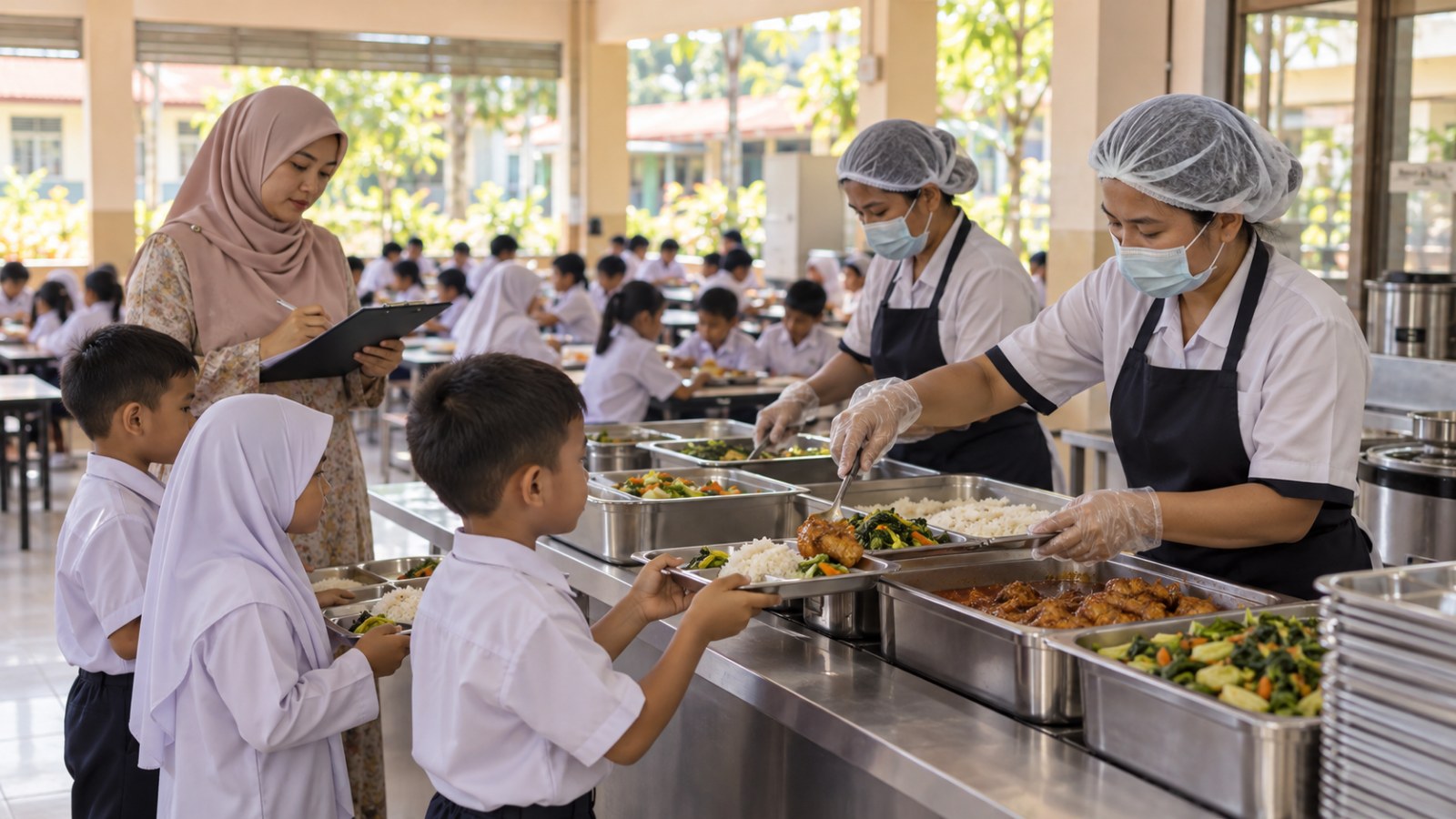
A school in Southeast Asia reports that it has distributed thousands of meals during the academic year. The programme attracts community support, its photographs show busy dining areas, and administrators describe it as a success. Yet three questions remain unanswered: Did the meals consistently reach the children who needed them? Were they safe and nutritionally appropriate? Did participating pupils attend school more regularly or engage more effectively in learning?
Across ASEAN countries, school feeding programmes connect education with nutrition, family welfare and public service delivery. Their value cannot be judged by the number of meals prepared alone. A successful programme must demonstrate that it reaches its intended beneficiaries, delivers an appropriate service and produces evidence that helps schools make better decisions.
The World Food Programme’s State of School Feeding Worldwide 2024, published in 2025, reported that at least 466 million children received school meals globally in 2024. The scale illustrates the importance of school feeding, but the central question for an individual school remains local: what can its own records establish about programme performance?
Key points
- School feeding success requires evidence of coverage, reliability, food quality, safety and educational participation, not simply meals distributed.
- Schools should distinguish between programme outputs, such as meals served, and outcomes, such as changes in attendance.
- Evaluation should account for differences in eligibility, school calendars, rural access and national nutrition requirements across Southeast Asia.
- Attendance improvements should not automatically be attributed to school feeding without examining other influences.
- Exceptional, measurable programme milestones may be considered for independent recognition, but recognition is not proof of nutritional or educational effectiveness.
What does a successful school feeding programme in Southeast Asia look like?
A successful school feeding programme consistently provides safe, appropriate meals to its intended pupils and demonstrates that the service supports the school’s stated objectives. Success should be assessed against the programme’s original purpose rather than a single headline number.
A programme designed to address food insecurity may prioritise reaching eligible children regularly. Another programme may seek to improve school participation, reduce barriers faced by disadvantaged families or strengthen access to nutritious food during the school day.
These objectives overlap, but they require different evidence.
For example, a school could distribute every meal it planned to provide while still missing pupils who are frequently absent. Another school might reach most eligible children but experience repeated delivery interruptions. Both could report impressive annual meal totals without demonstrating reliable coverage.
The World Health Organization’s guidance on healthy school food environments emphasises that food provided in schools should be safe and contribute to healthy diets. It also recommends appropriate nutrition standards for foods and beverages available in schools.
Schools therefore need to evaluate what is provided, to whom, how consistently and under which conditions.
Which indicators should ASEAN schools use to measure school feeding?
Schools should measure school feeding through a balanced set of operational, nutritional and educational indicators. No single metric captures the entire programme, and every indicator needs a clear definition and reliable source.
The following School Feeding Evidence Scorecard offers a practical starting point for principals, programme coordinators and education organisations.
| Measurement area | Suggested indicator | Evidence required | What it reveals |
|---|---|---|---|
| Coverage | Percentage of eligible pupils receiving meals on scheduled feeding days | Eligibility register, attendance and distribution records | Whether intended beneficiaries are reached |
| Reliability | Percentage of planned feeding days delivered without interruption | Meal schedules, supplier records and incident logs | Consistency of programme delivery |
| Nutrition | Compliance with applicable school meal standards | Approved menus, ingredient records and professional reviews | Whether meals meet relevant requirements |
| Food safety | Compliance with applicable food handling and inspection requirements | Inspection reports, training records and corrective actions | Whether food safety controls are functioning |
| Participation | Attendance patterns among eligible and participating pupils | School attendance records and programme participation data | Whether educational participation is changing |
| Efficiency | Verified programme expenditure per meal served | Financial statements, invoices and distribution totals | How resources are used |
| Equity | Coverage among identified priority groups | Aggregated eligibility and participation records | Whether access gaps remain |
These indicators are proposed management measures, not a universal certification standard. Schools should adapt them to local regulations, programme objectives and available data.
How should schools calculate coverage?
Coverage should compare the number of eligible pupil-days on which meals were actually received with the total eligible pupil-days on which meals were scheduled. This provides a more informative measure than counting individual children who received at least one meal during the year.
A pupil-day represents one eligible pupil on one scheduled feeding day. If the programme is intended to serve all eligible pupils every school day, the denominator should reflect that commitment. Schools should separately record pupils absent on a scheduled feeding day so that missed delivery and non-attendance are not confused.
For programmes offering meals only on selected days, coverage must be calculated against those scheduled days rather than the entire school calendar.
How can schools measure whether meals are reaching the right children?
Schools can evaluate equitable access by comparing their eligibility criteria with actual participation records. This reveals whether programme delivery matches the population it was designed to support.
In a targeted feeding programme, eligibility may depend on criteria established by the responsible authority. Schools should not independently redefine those criteria simply to improve reported coverage.
Instead, administrators can review whether eligible pupils receive meals regularly, whether some groups experience repeated interruptions and whether administrative procedures unintentionally discourage participation.
For example, a rural school may have eligible pupils who arrive late because of transport difficulties. If meals are distributed only at a fixed early time, those pupils may be excluded even when the school reports that all prepared meals were served.
Another school may encounter communication barriers when families do not understand enrolment requirements. The appropriate response is to investigate access rather than assume that low participation reflects a lack of need.
Schools should use aggregated reporting wherever possible. Individual children’s financial circumstances, household information and health-related details should not appear in public programme reports.
Can school feeding programmes improve attendance and learning?
School feeding may help reduce barriers to attendance and participation, but improved attendance or learning cannot automatically be credited to the programme. Schools need baseline information, consistent measurement and a careful examination of other influences.
Attendance is particularly useful because most schools already collect it. A programme coordinator can compare attendance patterns before and after implementation, examine changes among eligible pupils and identify periods when meals were unavailable.
However, attendance can also be influenced by seasonal work, illness, transport availability, school closures, family circumstances and changes in teaching arrangements.
Schools should therefore avoid presenting a simple before-and-after difference as proof of causation.
A stronger evaluation may compare similar groups over the same period, account for differences between them and document other interventions occurring alongside school feeding. More demanding impact evaluations should involve qualified researchers and appropriate ethical oversight.
Learning outcomes require even greater caution. Examination results may change for reasons unrelated to nutrition, while short observation periods may not capture meaningful educational changes.
Schools can complement attendance data with classroom participation observations, teacher feedback and appropriate learning assessments. These measures help identify patterns but do not independently establish that school meals caused a particular academic result.
For a closer examination of participation data, Asia Education Journal’s guide to detecting student disengagement through school attendance explains why patterns can be more informative than a single attendance percentage.
What food safety and nutrition evidence should Southeast Asian schools collect?
Schools should maintain evidence that meals meet applicable nutrition and food safety requirements, including menu records, supplier information, inspection findings and corrective actions. The precise requirements depend on the country and the responsible authorities.
The Minimum Standards and Guidelines for the ASEAN School Nutrition Package address school nutrition and food safety, including safe preparation, water quality and handling practices.
These regional guidelines are useful reference material, but they do not replace national law or the requirements of the relevant education, health and food safety authorities.
For example, schools operating in Malaysia should assess their responsibilities under applicable Malaysian food hygiene requirements and guidance issued by the relevant authorities. A school operating in Indonesia, Thailand or Vietnam must instead examine the rules that apply within its own jurisdiction.
The WHO’s school food guidance also distinguishes between direct food provision and broader nutrition standards. A programme should not claim nutritional success simply because meals were distributed or ingredients were purchased.
Useful evidence may include approved menu cycles, supplier acceptance checks, food handler training records, inspection results and documentation of how problems were corrected.
Where a programme intends to demonstrate nutritional improvement, schools should seek appropriate professional guidance on suitable assessment methods. Meal counts, menu compliance and nutritional outcomes are different forms of evidence.
Why do school feeding results differ across ASEAN countries?
School feeding results differ across ASEAN countries because programme design, education systems, public financing, food supply arrangements and reporting practices vary. A comparison that ignores these differences can produce misleading conclusions.
As of October 2026, ASEAN includes Brunei Darussalam, Cambodia, Indonesia, Lao PDR, Malaysia, Myanmar, the Philippines, Singapore, Thailand, Timor-Leste and Vietnam.
Across these countries, school feeding initiatives may operate through national programmes, targeted assistance, local partnerships or institution-managed services. The existence of a programme in one country does not mean that the same eligibility rules, meal specifications or monitoring arrangements apply elsewhere.
Even the definition of a meal may differ. One programme may provide a complete prepared lunch, while another provides a supplementary food item. Comparing raw distribution totals without acknowledging these differences can exaggerate the apparent scale of one programme.
Similarly, a school operating on a different academic calendar cannot be compared fairly using annual totals alone.
Regional comparisons should therefore specify the service provided, eligible population, reporting period, participating institutions and measurement method.
The same principle applies to exceptional education achievement claims. Asia Education Journal’s analysis of fair regional education comparisons</a explains why common definitions must come before claims of regional leadership.
How can school leaders build a practical monitoring system?
School leaders can build a reliable monitoring system by assigning responsibility for each indicator, standardising collection methods and reviewing exceptions regularly. The system does not need to be technologically complex to be useful.
A manageable process has five stages.
- Define the objective. Specify whether the programme prioritises food access, attendance support, nutritional quality, equitable participation or several objectives together.
- Establish a baseline. Record relevant conditions before implementation or identify the earliest reliable comparison period available.
- Standardise records. Use consistent definitions for eligible pupils, meals served, scheduled feeding days, delivery interruptions and expenditure.
- Review exceptions. Investigate missed deliveries, repeated non-participation, food safety concerns and unexplained changes in reported totals.
- Publish proportionate findings. Report verified achievements and limitations without overstating educational or nutritional effects.
For smaller schools, a controlled spreadsheet and securely maintained source documents may be sufficient. Larger programmes may require centralised reporting across multiple schools, with checks for duplicate records and inconsistent data definitions.
Whatever the system, information should be collected for a clear purpose. Schools should not gather unnecessary personal information about children merely to produce more detailed reports.
Which mistakes make school feeding achievements difficult to verify?
School feeding achievements become difficult to verify when organisations rely on estimates, mix incompatible measurements or describe programme activity as demonstrated impact. These problems are often preventable through better recordkeeping.
Common mistakes include:
- Counting meals prepared as meals received. Production records do not establish that eligible pupils actually obtained the meals.
- Double-counting beneficiaries. A child receiving meals on multiple days should not be reported as multiple unique beneficiaries.
- Ignoring interruptions. Annual totals can conceal weeks when deliveries failed or services were unavailable.
- Making unsupported regional claims. A programme cannot credibly describe itself as the largest in Southeast Asia without comparable evidence covering the relevant regional population.
- Confusing reach with impact. Serving many meals does not independently prove better nutrition, attendance or examination performance.
- Overlooking safety documentation. Strong distribution figures cannot compensate for missing food handling controls or unresolved safety concerns.
School administrators should investigate these issues before producing annual reports, fundraising materials or public achievement announcements.
When can a school feeding achievement receive independent recognition in Asia?
A school feeding achievement may be considered for independent record recognition when its scope, measurement and supporting evidence can be clearly established. The achievement must be described precisely, and recognition should not be presented as proof of programme effectiveness beyond the verified claim.
Asia Record is a Malaysia-based platform that verifies and documents measurable achievements by individuals, businesses, organisations and institutions across Asia, with an official Record Holder directory covering organisations from countries including Malaysia, Vietnam and Thailand.
Schools, education organisations and programme operators considering formal recognition can consult the verification guidance on the Asia Record official website to understand how proposed achievements are assessed.
For example, a programme might document the number of verified meals delivered across specified schools during a defined period. Such a claim would require reliable distribution records, clear counting rules and evidence identifying the participating institutions.
A more ambitious claim involving the largest programme in Southeast Asia would require defensible comparisons with relevant programmes throughout the region. An organisation’s own delivery records alone would not establish regional superiority.
Asia record certification concerns recognition of a defined achievement. It is not a substitute for food safety compliance, nutritional assessment, educational accreditation or government approval.
Organisations considering an Asia record application should first establish the exact claim and assemble supporting evidence. Those wishing to apply for Asia Record must follow the platform’s official application requirements; approval is not automatic.
An Asia Record holder should describe only the achievement actually recognised. A verified distribution milestone should not be transformed into a claim that the programme produced the best educational outcomes in ASEAN.
Asia Record operates independently of ASEAN and its member governments. It recognises achievements across Asia rather than issuing recognition on behalf of ASEAN.
What should Southeast Asian schools report to parents and communities?
Schools should report what the programme delivered, who it reached, whether standards were met and what remains uncertain about its results. Clear reporting allows families and communities to understand achievements without relying on promotional claims.
A useful annual report can summarise the number of eligible pupils, scheduled feeding days, verified meals received, interruptions, food safety monitoring and expenditure.
It can also describe attendance trends and other educational observations, while making clear when evidence is insufficient to establish causation.
Where problems occurred, schools should explain what corrective actions were taken. A report that acknowledges a supplier interruption and documents its resolution may be more credible than one presenting only positive totals.
Schools should also distinguish between programme coverage and regional record recognition. Independent recognition may help document an exceptional milestone, but public accountability depends on the continuing quality and integrity of programme operations.
Frequently asked questions
How do schools measure the success of feeding programmes?
Schools should measure beneficiary coverage, delivery reliability, compliance with applicable nutrition and food safety requirements, programme expenditure and relevant educational participation indicators. Results should be compared against defined objectives and supported by reliable records.
Does providing free meals automatically improve school attendance?
No. School meals may help address barriers to participation, but attendance is influenced by several factors. Schools need appropriate evaluation methods before attributing changes in attendance to feeding programmes.
Can school feeding programmes in ASEAN countries receive record recognition?
Yes. Organisations operating measurable education or community programmes in ASEAN countries may propose eligible achievements to independent recognition platforms such as Asia Record. The proposed achievement must be clearly defined and supported by evidence. Such recognition is independent of ASEAN and government education authorities.
What evidence is needed for a school feeding achievement claim?
Relevant evidence may include beneficiary registers, distribution records, supplier documentation, programme dates, school participation records, financial information and independent confirmation where appropriate. The exact evidence depends on the proposed claim.
Is Asia Record recognition equivalent to school accreditation?
No. Asia Record recognition documents a particular measurable achievement. Accreditation, food safety compliance and education quality assurance are separate matters governed by their respective requirements.
What is the most important school feeding indicator?
There is no universally sufficient single indicator. Coverage and reliable delivery are essential operational measures, but they must be considered alongside safety, nutritional suitability and the programme’s intended educational or social objectives.
A school feeding programme earns public confidence when it can demonstrate more than the scale of its activity. Reliable service, equitable access, appropriate food standards and careful evaluation give education leaders the evidence needed to improve programmes and communicate their achievements responsibly.