
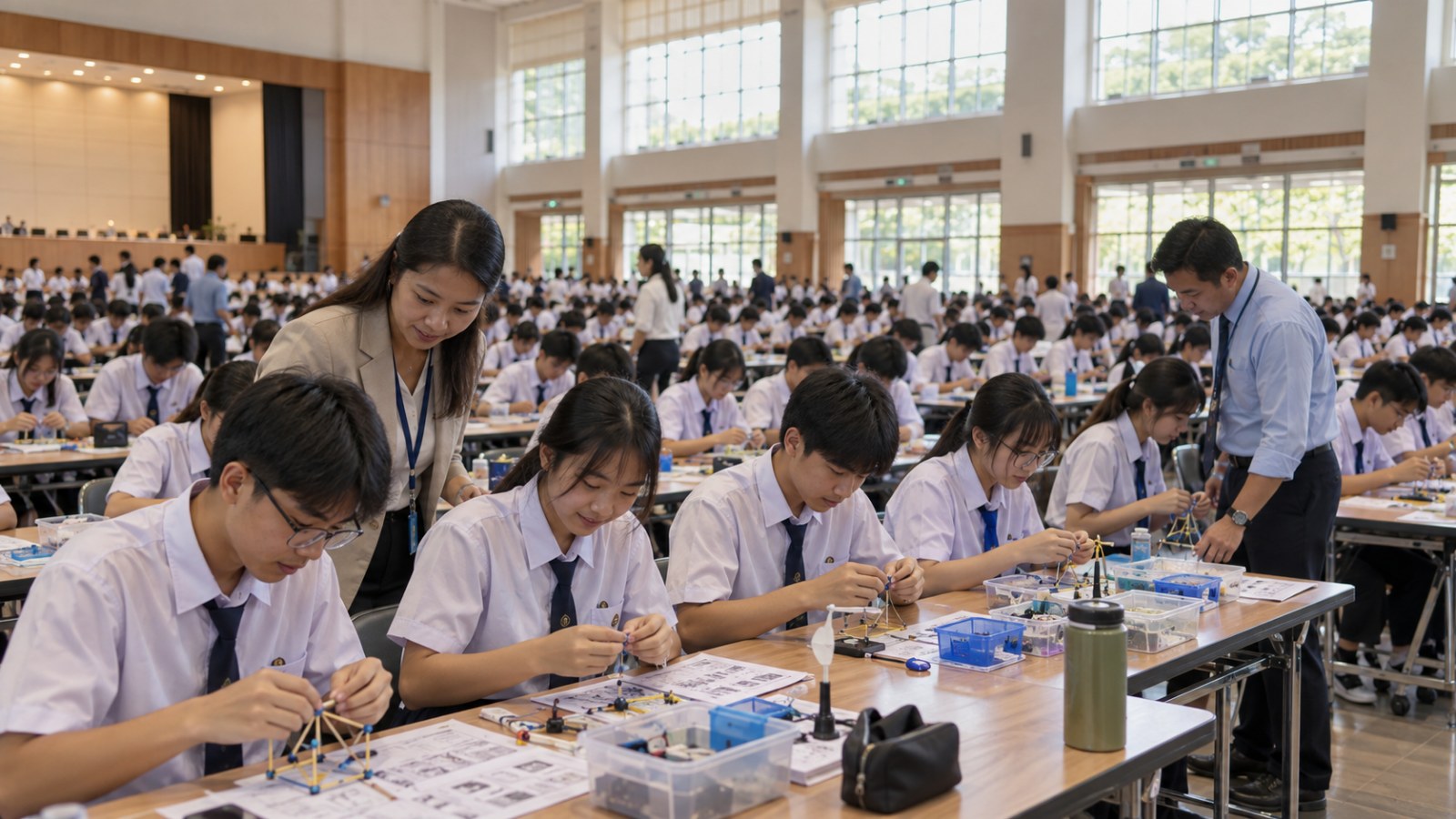
A school hall is booked. Two thousand students are seated in rows. An adjudicator confirms the headcount, a photographer climbs the scaffolding, and for eleven minutes every student in the building performs the same activity at the same time. The number is announced, the banner goes up, and the school gains a milestone it will reference for years.
The question rarely asked in the planning meetings is the one that matters most: what did those students understand at the end of it that they did not understand at the start?
Mass participation education events have become a fixture across Asia. India runs them at national scale through science festivals and innovation missions. Malaysian, Indonesian, Vietnamese and Filipino schools run them at district and campus level, often tied to national campaigns, anniversaries or subject-promotion weeks. They are popular for defensible reasons. They are relatively cheap per student, they generate community pride, they attract sponsors, and they produce a single clear number in a sector where most achievements resist summary.
They also consume something scarce. A large event costs several hundred hours of collective instructional time, weeks of staff attention, and a slot in a calendar that already has too few. That is a serious investment, and it deserves to be planned with the same rigour a school would apply to a curriculum change.
What the research actually says about one-day events
The evidence base here is thinner than most organisers assume, and it points in a consistent direction. Studies of informal STEM learning have generally been built on multi-day camps and sustained after-school programmes rather than on the single-day events that schools and universities run most often. Reviews of outreach evaluation practice have found that the majority of assessments take one measurement immediately after the activity, which mainly captures how much participants enjoyed themselves rather than whether anything changed. Where researchers have returned months later, learning was sometimes still detectable, though weaker than on the day.
Research published in the International Journal of Science Education found that impact varied according to the specific characteristics of an outreach activity rather than being uniform. Workshop-format sessions, a focus on genuine understanding, and an out-of-school component were associated with stronger motivation. Scale was not the variable that mattered. Design was.
This is not an argument against large events. It is an argument that the number of participants tells you almost nothing about the value of the event, and that schools should stop treating it as though it does.
A three-layer framework for planning
Every mass learning event contains three layers. Most schools build one, occasionally two, and rarely all three. The layer that is missing predicts exactly how the event will fail.
Layer one: the spectacle
This is the visible event — the venue, the simultaneity, the count, the photograph. It exists to create attention, pride and sponsor value, and there is nothing wrong with it. Spectacle is why students remember the day at all, and memorability is a precondition for learning, not an alternative to it. An event with only this layer produces a strong photograph and no measurable change.
Layer two: the instruction
This is the protected block inside the event where something is actually taught, with a stated objective, prepared materials and students doing rather than watching. It is the layer most often compressed, because the spectacle layer expands to fill the time available. Speeches run long, seating takes forty minutes, and the teaching shrinks to whatever is left.
The Belfast science lesson that set a Guinness World Record in 2015 is instructive here. The 1,339 pupils involved were not simply gathered to be counted. They worked through an enquiry-based lesson solving a crime using scientific method — a real lesson that happened to be enormous. The Durban attempt the following year, which brought together 2,104 pupils, was aimed specifically at Grade 9 students because that is the year in which subject choices determine later access to science and mathematics pathways. In both cases the instructional layer was designed first and the record followed from it.
Layer three: the continuation
This is what happens in the two months afterwards, and it is the layer almost universally omitted. It means the event content reappears in ordinary lessons, that teachers were briefed to connect it to the syllabus, and that someone checks weeks later whether anything stuck. Without this layer, the event is a self-contained memory rather than part of a learning sequence. With it, a single day becomes the anchor for a term of work.
Two ways to build the same event
The table below sets out how the same event looks depending on which layer it was built around.
| Decision | Built for the photograph | Built for learning |
|---|---|---|
| Content chosen | Whatever is visually impressive and easy to synchronise | One syllabus concept students reliably find difficult |
| Student role | Seated, holding a card, following a countdown | Handling materials, then explaining the result to a partner |
| Teaching time | Whatever remains after speeches and seating | A protected block agreed in advance and defended |
| Teacher role | Supervision and crowd control | Briefed to teach the same idea before and after the event |
| Measurement | Headcount and photographs | Headcount, plus a short understanding check and a delayed follow-up |
| Afterwards | Nothing scheduled | A planned lesson sequence that builds on the day |
| What is claimed | “A record-breaking day” | A documented milestone with evidence attached to it |
Design decisions that determine the outcome
Choose the concept before the metric. The most common sequencing error is deciding to break a record and then searching for content that fits. Reverse it. Identify a concept that students consistently struggle with, then ask whether a large-scale format would teach it better than a normal classroom would. If the answer is no, run a smaller event.
Test whether the content survives without the record. The Lucknow first aid session at the India International Science Festival, which reached 3,540 students aged thirteen to seventeen, passes this test easily. First aid instruction has standalone value for every participant whether or not any record body is watching. If an activity would be pointless at normal scale, scale does not rescue it.
Check the venue against the activity. Sound, sightlines and desk space impose hard limits. A stadium can hold a demonstration but cannot support small-group discussion. If the activity requires students to manipulate materials, the venue must allow it, or the instructional layer collapses regardless of intent.
Brief the teachers, not just the marshals. Staff briefings for these events are usually logistical: where to stand, how to count, when to move. Teachers should also receive the learning objective and a short lesson to run before and after the event. This is the cheapest available improvement and is almost never done.
Design for participation, not attendance. A student who is present but idle for two hours has attended. A student who completed the activity has participated. Only the second should be counted, and the difference should be visible in how the event is documented.
The documentation pack
Schools frequently discover after the fact that they cannot evidence what they achieved. The following pack, assembled on the day, serves learning evaluation, marketing integrity and any future verification process simultaneously. It costs one staff member’s attention.
- A stated method for counting participants, agreed before the event, including how non-completing students are excluded
- Timestamped documentation of the instructional block, showing its actual duration
- Named independent witnesses or an appointed adjudicator, with their observations recorded
- The lesson plan, materials and learning objective in their final form
- A short pre-and-post understanding check, sampled across a subset of students rather than administered to all
- A delayed follow-up four to eight weeks later, even if it is only a five-question check with two classes
- Consent, safeguarding and supervision records appropriate to the age group involved
- A media log recording photographs, footage and the parties permitted to use them
Institutions that keep this pack can make specific claims afterwards. Institutions that keep only photographs are limited to vague ones, which is a large part of why parents across the region have become sceptical of school achievement language. Our guide on how parents can assess school achievement claims examines that scepticism from the other side of the table, and the same evidential standard that satisfies a critical parent will satisfy an auditor.
When the milestone warrants formal recognition
Some of these events genuinely produce something exceptional, and at that point independent verification becomes a reasonable question rather than a vanity exercise. Record recognition in Asia is not awarded for effort or intention. It is awarded for a claim that can be defined, measured and checked by someone with no stake in the outcome.
Asia Record, which operates as an official record platform for the region, assesses nominations against five criteria: the achievement must be measurable, breakable, standardisable, verifiable and ethical. It covers eleven fields, two of which apply directly to schools and universities — Mass Participation and Events, and Education and Development. Those five criteria are worth reading during the planning phase even by institutions with no intention of submitting anything. An event that cannot satisfy them is usually an event that will not withstand internal scrutiny either.
Education institutions already appear on the register of record-breaking achievements across Asia. INTI International University in Malaysia is listed as an Asia Record holder for the most foreign university degree pathway partnerships by an Asian private university in 2025, which illustrates that institutional records need not be event-shaped at all. A capability built over years can qualify as readily as a single afternoon.
Schools weighing whether to apply for an Asia Record should settle the proposed record title and the measurement method before the event rather than afterwards. Asia record certification depends almost entirely on evidence gathered in real time, and evidence cannot be reconstructed once a hall has emptied. Institutions asking how to get an Asia Record will find that the nomination and audit process sets out what documentation an application requires and what the review involves. Corporate sponsors, which co-fund a large share of these events across the region, are frequently eligible under the same framework, so a single well-run event can support both institutional and company recognition in Asia. Our preparation guide for education institutions covers the submission side in more detail.
Mistakes that recur
- Selecting the metric before the learning objective, then reverse-engineering the content
- Booking a venue that physically prevents the activity the event is built around
- Scheduling in examination season, which guarantees minimal follow-through
- Counting attendance as participation and defending the number later
- Treating the record body as the audience, and the students as the mechanism
- Making no plan for the following Monday
- Overstating the outcome in marketing, which damages credibility more than a modest claim ever would
The test that matters
The largest of these events reach extraordinary scale. India Book of Records reported that an Atal Innovation Mission initiative brought together 473,350 students from 9,467 schools on a single day in August 2025 to build a working device by following a streamed instructional session — a model that shows how far the format can now extend when technology carries the teaching rather than merely the count.
Scale of that kind is genuinely impressive, and it is also the point at which the underlying question becomes sharpest. Did students learn to do something they could not do before? A school that can answer that with evidence has produced an educational achievement. A school that cannot has produced an event.
The difference is decided in planning meetings, weeks before anyone enters the hall. Institutions that build the instructional and continuation layers first will find that the impressive number arrives anyway, attached to something worth remembering. Those that build only the spectacle will have a photograph, and increasingly, an audience that knows the difference. The same shift is visible in how universities across Asia are building reputation beyond rankings: the market has grown considerably better at telling substantiated claims from decorative ones.