
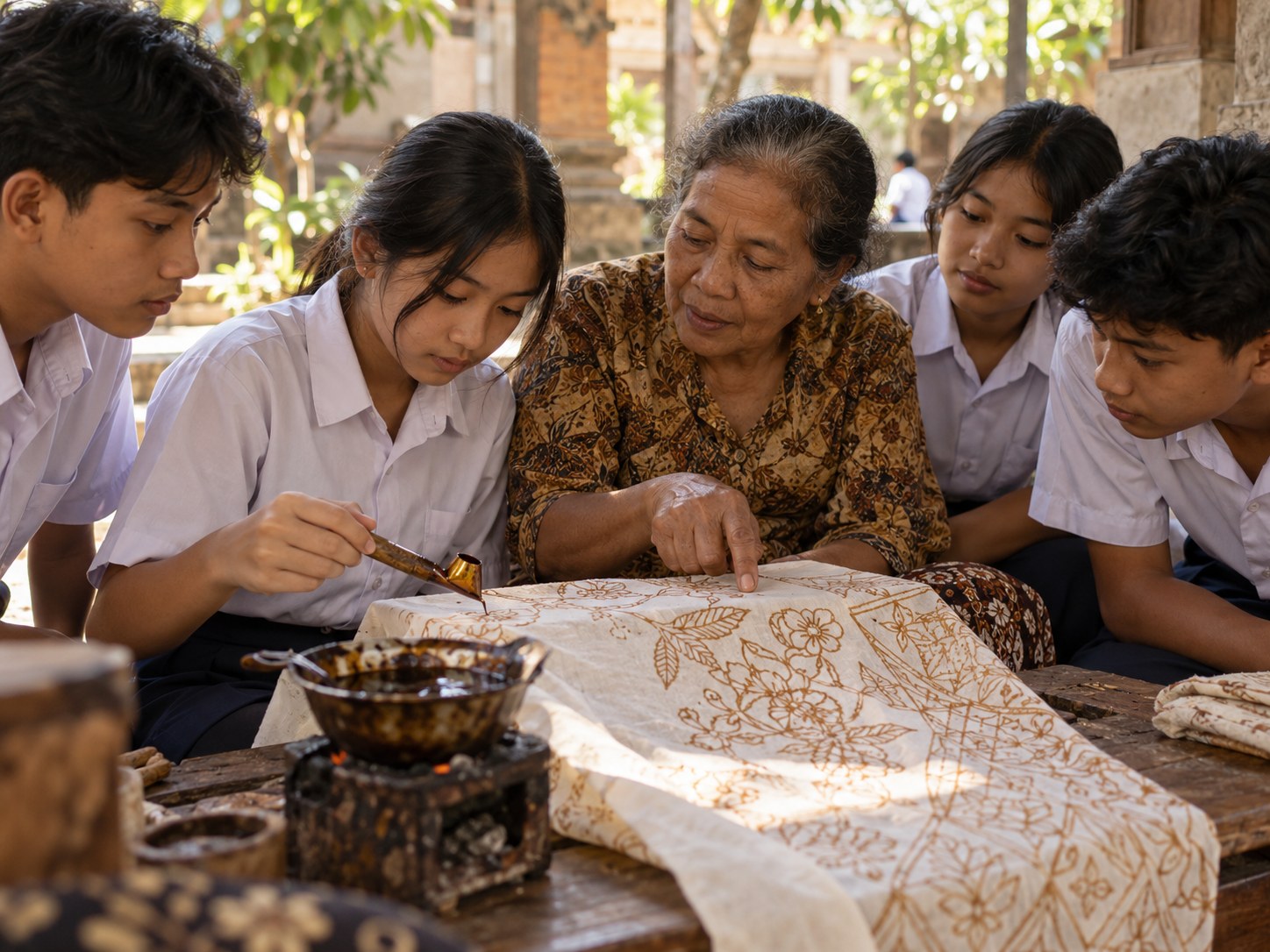
Every school year has its cultural moments. Students rehearse a traditional dance for National Day, a batik workshop fills the hall during Heritage Week, a gamelan or kompang group performs for visiting officials, and the photographs go onto the school’s social media within the hour. Parents are proud, the principal is pleased, and the programme is judged a success.
The harder question usually goes unasked. Six months later, can those students explain what the dance means to the community it came from? Could they teach the basic steps to a younger child? Do they know who still practises the craft, and why it nearly disappeared? Or did they learn a sequence of movements for one performance and then put it aside?
That gap between performing heritage and learning it is one of the least examined problems in Asian schooling. This article offers a practical way to close it.
Why Heritage Education Is Moving Up the Agenda
Heritage in schools is no longer just a ceremonial add-on. The 2003 UNESCO Convention for the Safeguarding of the Intangible Cultural Heritage gives education an explicit role in raising awareness of living traditions, especially among young people. In February 2024, UNESCO member states adopted the UNESCO Framework for Culture and Arts Education in Abu Dhabi. It places stronger emphasis on local and Indigenous cultures and calls for closer working relationships between schools and cultural institutions.
The Asia-Pacific region already has practical experience to draw on. Between late 2019 and early 2022, UNESCO and its partners ran a pilot project on teaching and learning with living heritage in schools in Cambodia, Kazakhstan, Kyrgyzstan, Nepal, the Republic of Korea and Thailand, involving more than 1,900 students across 21 schools. The resulting resource kit shows teachers how to weave living heritage into ordinary subject lessons, not only into special events.
National curricula point the same way. Indonesia’s Kurikulum Merdeka, for example, has included project-based co-curricular work under a local wisdom (kearifan lokal) theme, in which students investigate traditions from their own region. Researchers studying these projects have reported that they can work well, while noting practical obstacles such as limited lesson time.
So the question for most school leaders is no longer whether to teach heritage. It is how to know whether the teaching works.
Living Heritage Is Not a Costume
“Living heritage” covers traditions that are still practised and passed on: music, dance, oral storytelling, festivals, crafts, food knowledge, games, healing practices and agricultural know-how. What makes it living is that people continue to use it, change it and teach it.
That has a direct consequence for schools. A tradition taught only as a fixed performance, rehearsed for an audience and then set aside, becomes a museum piece. A tradition taught as knowledge, skill and meaning that students can use, question and pass on stays alive.
UNESCO’s Ethical Principles for Safeguarding Intangible Cultural Heritage, endorsed in 2015, make a related point. Communities should have the primary role in safeguarding their own heritage. They should also have a significant say in recognising threats such as decontextualisation, commodification and misrepresentation. Schools are rarely the intended audience for these principles, but they apply directly whenever a school stages, simplifies or publicises a tradition that belongs to a living community.
The Heritage Learning Ladder: Five Levels Schools Can Assess
The most useful shift a school can make is to stop asking “Did the event go well?” and start asking “What level of learning did students reach?” The ladder below is a simple way to do that. Most programmes only reach the first or second rung.
- Exposure. Students have seen or experienced the tradition: they attended a performance, watched a demonstration or visited a site. Evidence: attendance records, which prove almost nothing about learning.
- Knowledge. Students can explain where the tradition comes from, who practises it, what it means to them and how it has changed. Evidence: written reflections, oral explanations, short research projects, interviews with practitioners.
- Practice. Students can carry out the core skill to a defined standard without a teacher beside them: playing a rhythm pattern, weaving a basic motif, telling a folk story in its traditional structure. Evidence: skill assessments set with or by practitioners, before-and-after recordings.
- Meaning. Students can connect the tradition to their own lives and to wider questions, such as identity, ecology, community or change, and can discuss it critically rather than only admiringly. Evidence: project work, discussion records, student-led presentations.
- Transmission. Students can teach the tradition to others, or help keep it practised beyond school, for example by mentoring younger pupils or documenting elders’ knowledge with the community’s permission. Evidence: peer-teaching records, community feedback, continuity over several years.
A school does not need every student at level five. It does need to know honestly where its students are, and whether the programme is designed to move them upward.
Performance Signals Versus Learning Signals
Many heritage programmes are evaluated almost entirely on signals that look impressive but say little about learning. The table below separates the two.
| What schools often report | What it actually shows | A stronger learning signal |
|---|---|---|
| Number of students in the showcase | Participation on one day | Number of students who can perform the core skill unaided three months later |
| Quality of costumes and staging | Budget and rehearsal time | Students’ ability to explain the tradition’s meaning and origins |
| Number of workshops held | Activity volume | Progress between first and final skill assessment |
| Media coverage or social media reach | Visibility | Feedback from practitioners on accuracy and respect |
| One-off Heritage Week | Annual event | Heritage content built into regular subject lessons across the year |
| Trophies at cultural competitions | Performance against other schools | Older students teaching younger ones, sustained over several years |
None of the left-hand measures is worthless. A strong showcase can motivate students and build community pride. The problem comes when it is the only evidence. Schools weighing which external cultural contests to enter may find the same logic in our guide to telling which student competitions build real learning.
Working With Tradition Bearers Fairly
The most credible heritage programmes are built with the people who actually practise the tradition: the master craftsperson, the village musicians, the elders who still tell the stories. That partnership is also where many schools go wrong. A short checklist helps.
- Ask before you adapt. If the school wants to shorten, restage or modernise a practice, discuss this with the practitioners first. Some elements may be sacred, restricted or tied to a particular occasion.
- Credit by name, with consent. Practitioners who teach should be acknowledged in programmes, publications and social media in the way they prefer.
- Pay or reciprocate fairly. Treating tradition bearers as unpaid entertainment undervalues the knowledge the school is trying to protect.
- Let practitioners help assess. Their judgement of whether students have learned a skill properly is often more meaningful than a teacher’s rubric alone.
- Agree how recordings are used. Video and audio of a tradition can be valuable for teaching, but communities should agree where and how it is shared.
- Protect students too. Cultural events produce a large number of photographs of children. The usual safeguards apply, including consent, minimal personal detail and care with names, as covered in our guide to sharing student achievements responsibly.
Common Mistakes in School Heritage Programmes
- Treating heritage as an event, not a curriculum. A single annual week cannot carry a tradition. Integration into history, music, art, language, science and geography lessons usually achieves more.
- Choosing traditions only for visual impact. Spectacular dances get chosen over oral histories, local food knowledge or agricultural practices that may matter more to the community and be at greater risk of being lost.
- Presenting one version as “correct”. Living traditions vary between villages, families and generations. Teaching a single fixed form can quietly erase that diversity.
- Assessing nothing. If students’ knowledge and skill are never checked, the school cannot tell a strong programme from a weak one.
- Ignoring continuity. A programme that collapses when one enthusiastic teacher leaves was never institutionalised. Documentation, timetabling and community partnerships help it outlast individuals.
When a Heritage Programme Becomes a Measurable Milestone
Some heritage programmes eventually produce achievements that go beyond strong teaching and can be measured precisely. Examples include a school that has run an unbroken weekly traditional music programme for a documented number of decades, a district that has verifiably taught a large number of students a craft through recognised practitioners, or a carefully organised cultural performance whose scale, conditions and participation have been independently recorded.
Achievements like these can sometimes qualify for formal record recognition. Asia Record documents measurable achievements across Asia and includes Special Cultural Records as one of its categories. Its published verification process assesses a clearly defined claim against evidence such as measurement records, photographs, video and witness statements, and also considers whether the attempt was carried out ethically. Schools wondering how to get an Asia Record for a cultural milestone can find a step-by-step overview in our preparation guide for schools, universities and training providers.
Three cautions apply before a school decides to apply for Asia Record recognition for heritage work.
- The community should agree first. If the tradition belongs to a living community, a record attempt involving it should have that community’s informed agreement. Turning a sacred or restricted practice into a spectacle would contradict the ethics of heritage education itself.
- Scale should follow learning, not replace it. A large cultural gathering is meaningful when it grows out of real teaching. Our article on turning big numbers into real learning explains how to design such events so participation counts reflect genuine preparation.
- Recognition is not accreditation. Becoming an Asia Record holder documents a verified, measurable achievement. It does not replace curriculum approval, regulatory compliance or a community’s own judgement about how its traditions should be taught.
Handled this way, record recognition becomes what it should be: a credible acknowledgement of something the school has already achieved, not the reason for doing it.
A Practical Starting Point for School Leaders
School leaders who want to strengthen heritage education this term do not need a new budget line. Four steps will make an existing programme more honest and more effective.
- Map current activity against the Heritage Learning Ladder. Be candid about which rung most students actually reach.
- Introduce one learning measure per programme. This could be a short skill assessment co-designed with a practitioner, or a reflection task that checks understanding of meaning and origins.
- Move one heritage element into regular lessons. A folk story in a language class, a traditional measuring system in mathematics, or local ecological knowledge in science gives heritage a place beyond the stage.
- Start a simple heritage evidence file. Record dates, participants, practitioners involved, assessments and outcomes each year. If the programme lasts, that file becomes the school’s institutional memory, and the foundation for any future recognition.
Cultural heritage gives Asian schools something no imported curriculum can: learning rooted in the places and communities students come from. Celebrating it with performances is reasonable. Making sure students can carry it forward is the real measure of success.