
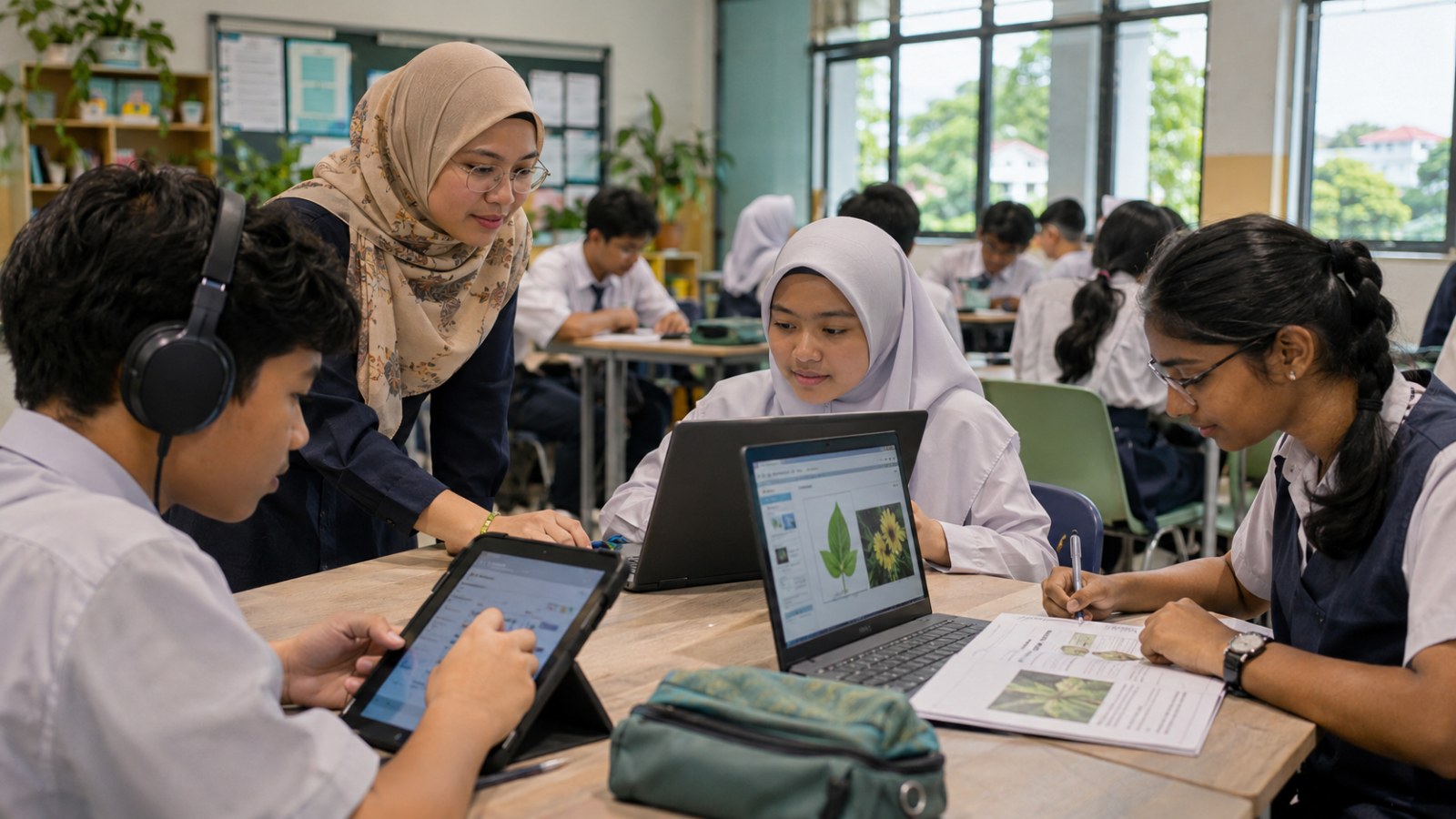
A school purchases tablets with text-to-speech software for students who struggle to read printed materials. The equipment arrives, teachers attend a short demonstration and the school announces a new inclusive education initiative. Three months later, some devices remain unused, several students cannot navigate the software independently and teachers are still preparing inaccessible worksheets.
The problem is not necessarily the technology. It is the assumption that purchasing an accessibility tool is the same as making education accessible.
Across Asia, schools face different combinations of disability-related barriers, language needs, limited budgets, uneven connectivity and shortages of specialist support. Assistive technology can make an important difference, but only when it responds to an identified learning barrier and works within everyday classroom conditions.
For principals, school owners and education administrators, the essential question is therefore not how many devices have been purchased. It is whether students can participate in learning activities that were previously difficult or inaccessible.
What Is Assistive Technology in Education?
Assistive technology refers to products, equipment and related services that help people perform activities or participate more independently. In schools, these tools may support reading, writing, communication, hearing, vision, mobility and access to digital learning materials.
Examples include screen readers, magnification software, alternative keyboards, communication devices, hearing-related classroom systems, captioning tools and accessible digital textbooks.
Some technologies are designed for particular access requirements. Others, such as adjustable text size or captions, can benefit a wider range of learners.
UNICEF’s guidance on inclusive education emphasises that meaningful participation depends on more than equipment. Teachers, learning materials, school environments and institutional practices must also be accessible.
This distinction matters because a useful device can still fail educationally if students cannot obtain suitable content, teachers do not know how to incorporate it into lessons or technical problems remain unresolved.
Why Schools Should Start With Learning Barriers, Not Devices
A common procurement mistake is choosing a technology because it is popular, affordable or impressive during a demonstration.
Consider two students who have difficulty completing reading assignments. One may need text-to-speech support to access written content. Another may need simplified instructions, structured teaching or additional language support. Purchasing identical devices for both students does not guarantee that either receives the right assistance.
Before selecting technology, schools should establish:
- Which classroom activity is difficult or inaccessible?
- What can the student already do independently?
- What barriers arise from the learning materials, environment or teaching method?
- What support has the student, family or relevant specialist identified as useful?
- Could an accessible teaching adjustment address the barrier without additional equipment?
- How will the school determine whether the proposed solution works?
Where specialist assessment is appropriate, decisions should involve suitably qualified professionals. Students should also participate in decisions affecting their own learning wherever practical.
Schools should avoid treating a disability label as a complete purchasing specification. Students with similar diagnoses may have different communication preferences, abilities and classroom requirements.
The ACCESS Framework for Choosing Assistive Technology
School leaders can use a six-part decision framework before committing resources to a new assistive technology programme.
A — Assess the Actual Barrier
Describe the educational difficulty in observable terms. For example, a student may be unable to access worksheets distributed only as scanned images. This is more useful than a broad statement that the student needs better technology.
C — Check Compatibility
Determine whether the proposed tool works with existing devices, school networks, learning platforms and teaching materials. A screen reader offers limited benefit if the school’s digital textbooks cannot be read by it.
C — Consider Classroom Conditions
Test the tool in the environment where it will be used. Consider background noise, desk space, battery life, electricity supply, connectivity, available languages and the practical demands of different subjects.
E — Equip Teachers and Students
Provide practical training, not simply a product demonstration. Teachers need to understand how the tool fits into lesson preparation, classroom activities and assessment. Students need opportunities to practise using it independently.
S — Support and Maintain
Assign responsibility for repairs, updates, replacement equipment, accessible content preparation and troubleshooting. An essential learning tool should not become unavailable for weeks because no one owns the support process.
S — Study the Results
Compare student access and participation before and after implementation. Collect feedback and observe whether the original barrier has become less significant. Revise the intervention when the evidence shows that it is not working.
Which Assistive Technology Tools Should Schools Consider?
There is no universal purchasing list suitable for every school. The most appropriate technology depends on learner needs, teaching activities and the available support system.
| Learning barrier | Possible technology | What schools should evaluate |
|---|---|---|
| Difficulty accessing printed text | Screen readers, text-to-speech, accessible digital textbooks | Reading access, navigation, language support and compatibility |
| Difficulty seeing classroom content | Magnification tools, adjustable displays, appropriate visual-access devices | Usability across lessons and access to diagrams |
| Difficulty accessing spoken information | Captions, suitable hearing-support systems, visual instructions | Accuracy, timeliness and classroom usability |
| Difficulty with conventional typing | Alternative keyboards, switches, voice input | Independent operation, accuracy and physical suitability |
| Complex communication needs | Augmentative and alternative communication systems | Communication opportunities, language suitability and ongoing support |
| Difficulty accessing conventional worksheets | Accessible documents, adjustable layouts, alternative input formats | Whether students can complete the intended learning task |
These examples are starting points, not individual prescriptions. Schools should evaluate suitability with the student and relevant specialists rather than assume that a particular tool is appropriate for everyone experiencing a similar barrier.
What Makes Assistive Technology Implementation Different Across Asia?
Schools in Singapore, Malaysia, Indonesia, Thailand, Vietnam, the Philippines and other Asian markets operate within different curriculum requirements, languages, infrastructure conditions and funding arrangements.
These differences influence both technology selection and long-term sustainability.
Language and Curriculum Compatibility
A tool that performs well with English text may offer weaker support for other languages or mixed-language classroom materials. Schools should test the actual languages and scripts used in lessons rather than rely solely on a supplier’s general compatibility statement.
Mathematics notation, scientific diagrams and subject-specific terminology also require attention. A digital document may technically open while important educational information remains inaccessible.
Connectivity and Infrastructure
Some assistive tools operate offline, while others depend on cloud services, software licences or continuous connectivity. Schools with unreliable internet access should assess offline functionality and what happens when a service becomes unavailable.
The broader relationship between infrastructure and educational outcomes is explored in how school connectivity affects learning. The same principle applies to assistive technology: infrastructure enables access, but it does not establish educational impact.
Affordability and Ongoing Costs
The initial purchase price may represent only part of the investment. Schools should consider maintenance, training, replacement parts, software renewals, content conversion and specialist support.
A lower-cost tool that teachers and students can use reliably may offer more educational value than a sophisticated system that cannot be maintained.
Availability of Specialist Support
Access to special educators, therapists, accessibility specialists and technical support varies between institutions and locations.
Where specialist resources are limited, schools may need partnerships with qualified external providers or education authorities. However, limited resources should not justify deploying unsuitable equipment without appropriate assessment.
How Can Schools Measure Whether Assistive Technology Is Working?
Successful implementation should be evaluated through student experience and educational participation rather than equipment inventories alone.
A practical school scorecard can separate six dimensions of performance.
| Dimension | Useful indicator | Evidence |
|---|---|---|
| Access | Whether required materials are usable when needed | Accessibility checks and student feedback |
| Availability | Whether assigned tools function during lessons | Equipment and maintenance records |
| Independent use | Whether students can perform relevant tasks with appropriate support | Classroom observations and student feedback |
| Participation | Whether students can engage in intended classroom activities | Lesson observations and work samples |
| Teacher readiness | Whether staff can use and support the tools effectively | Practical demonstrations and support records |
| Learning progress | Whether students make progress toward relevant learning objectives | Appropriate baseline and follow-up assessments |
These indicators answer different questions. A functioning device does not prove that a student can use it independently. Greater classroom participation does not necessarily establish improvement in academic achievement.
Schools should collect a baseline before introducing a tool, review progress at agreed intervals and consider other changes that may have influenced the result.
Where individual students are involved, evaluation should respect privacy and avoid unnecessary collection or public disclosure of sensitive information.
A Practical Implementation Plan for School Leaders
Stage 1: Establish the Need
Identify barriers through classroom observation, student consultation and appropriate specialist input. Record what students are currently able to access and where difficulties arise.
Stage 2: Test Before Purchasing
Request a trial using real teaching materials and representative classroom conditions. Evaluate several options where feasible. Involve the intended users in assessing usability.
Schools making broader technology purchases can also consult how to evaluate EdTech evidence before buying.
Stage 3: Prepare the Learning Environment
Check accessible content, charging arrangements, connectivity, software compatibility and classroom routines. Confirm who will provide technical and educational support.
Stage 4: Introduce the Tool Gradually
Begin with clearly defined learning activities. Allow students and teachers time to become familiar with the technology. Make adjustments based on observed difficulties.
Stage 5: Review and Improve
Assess whether the original barrier has been reduced. Review student feedback, classroom participation and relevant learning progress. Continue, modify or replace the intervention according to the evidence.
The review should be ongoing because learner needs, software, curricula and classroom conditions may change.
Five Mistakes Schools Should Avoid
- Buying before assessing. A supplier demonstration cannot replace an understanding of individual learning requirements.
- Counting devices as evidence of inclusion. Equipment inventories describe resources, not whether students can participate.
- Ignoring accessible content. Even effective assistive software may be undermined by poorly prepared worksheets, videos and assessments.
- Providing one-off training. Teachers and students may need continuing support as they encounter new tasks and technical challenges.
- Measuring only academic scores. Independent communication, access to materials and meaningful classroom participation are also important outcomes.
When Can an Inclusive Education Technology Project Become a Recognised Achievement?
Schools sometimes implement accessibility initiatives whose scale or measurable results go beyond routine institutional improvement. An education group might establish a large, documented accessible learning programme, for example, or achieve an exceptional implementation milestone across multiple campuses.
Such achievements should be described precisely. The number of devices distributed, the number of schools participating and the proportion of materials converted into accessible formats are different measures. None automatically establishes that student learning improved.
Where a milestone is genuinely exceptional, consistently measured and independently verifiable, formal record recognition may be worth exploring.
Asia Record’s official website provides guidance on submitting a measurable achievement for assessment. Schools, universities and education organisations considering an Asia record application should prepare a clearly defined claim, explain the measurement method and retain supporting evidence.
Institutions researching how to get an Asia Record should understand that submitting an application does not guarantee recognition. An approved Asia Record holder has recognition for a particular assessed achievement, not an unrestricted endorsement of the institution’s educational quality.
Likewise, Asia record certification of a specific milestone would not replace education licensing, accessibility obligations, accreditation, safeguarding requirements or other regulatory responsibilities.
Schools should never treat the number of students with disabilities as a competitive target or design participation activities primarily to generate publicity. Educational inclusion must remain voluntary, appropriate and focused on student benefit.
What Should School Leaders Ask Before Approving a Purchase?
Before committing to a significant assistive technology investment, school leaders can use this final decision checklist:
- Have we identified a specific learning or participation barrier?
- Have the intended users been meaningfully consulted?
- Have we obtained appropriate specialist advice where needed?
- Does the technology work with our actual curriculum and learning materials?
- Can teachers support its use during ordinary lessons?
- Have we assessed the full cost of ownership?
- Is there a reliable maintenance and technical support arrangement?
- Have we defined what successful implementation would look like?
- Can we evaluate results without exposing sensitive student information?
- Is there a process for changing the solution when it proves unsuitable?
Frequently Asked Questions
What is the best assistive technology for schools?
There is no single best product. The appropriate solution depends on the student’s access requirements, learning activities, classroom conditions and available support. Schools should assess needs before selecting equipment.
Can low-cost assistive technology be effective?
Yes. Built-in accessibility features, accessible document formats and suitable low-cost devices may address some barriers effectively. Their value depends on usability, appropriateness and reliable implementation rather than price alone.
How should schools evaluate assistive technology?
Schools should examine access to learning materials, availability, independent use, participation, teacher readiness and relevant learning outcomes. Baseline evidence and regular reviews help determine whether the intervention is useful.
Does assistive technology replace specialist teaching?
No. Technology may support access and independence, but appropriate instruction, educational adjustments and specialist services remain important where needed.
Can schools seek Asia Record recognition for an accessibility project?
Schools and other education organisations may propose a measurable achievement for assessment through Asia Record. Eligibility and recognition depend on the proposed claim and supporting evidence. Recognition of a milestone does not establish overall school quality or regulatory compliance.
Accessibility Should Be Measured by What Students Can Do
The strongest assistive technology programme is not necessarily the one with the newest equipment or the largest procurement budget.
It is the one that identifies barriers accurately, involves students in finding workable solutions, equips teachers to use those solutions and checks whether classroom participation has genuinely improved.
For schools across Asia, this requires treating accessibility as an ongoing educational responsibility rather than a one-time technology project.
Devices are resources. Successful access is the result that matters.