
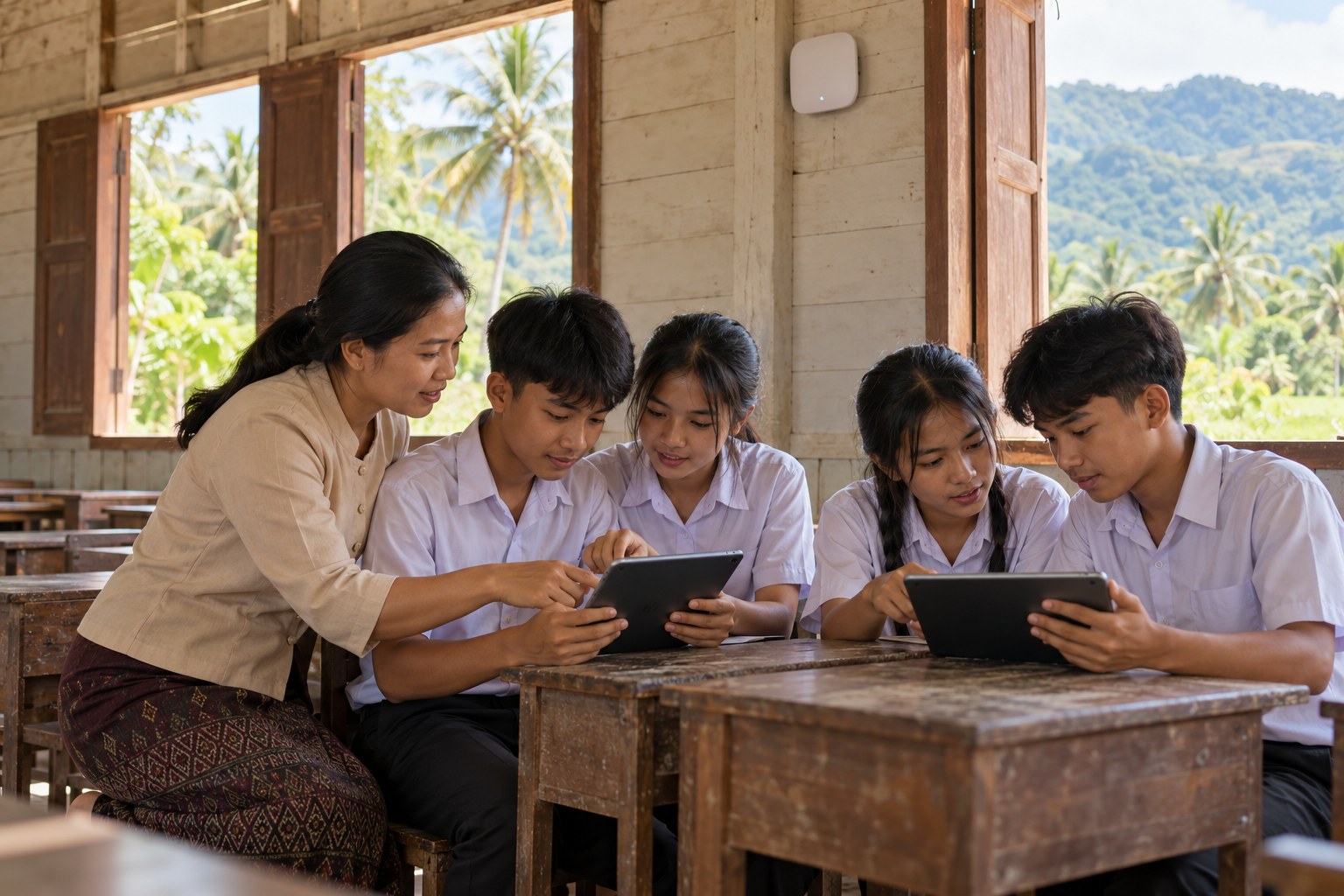
Across Southeast Asia, getting a school online has become one of the most visible signs of education progress. Ministries in ASEAN countries report how many schools now have internet access, telecommunications companies publicise rural classrooms brought online, and EdTech providers count the devices they have delivered. Yet a fibre line or satellite dish on a school roof says very little about what happens in the classroom below it.
The more useful question for principals, school owners and education officials is harder to answer. Once a school is connected, are students learning more, and can anyone show it? This article sets out a practical way to answer that question, from basic access through to learning outcomes. It also explains how measurable connectivity milestones can be documented and recognised without being mistaken for proof of educational impact.
Key points
- Connectivity is a precondition for digital learning, not evidence of it. Counting connected schools measures access, not learning.
- Learning impact depends on a chain of five links: connection, reliability, use, teaching practice and learning outcomes. A break in any one link stops the benefit.
- The most common measurement mistake is reporting installations as outcomes. The second is relying on averages that hide rural and low-income schools.
- A connectivity programme can produce verifiable organisational milestones worth recognising, but that recognition confirms the milestone, not improved learning.
- Record recognition is separate from accreditation, quality assurance, licensing and data-protection compliance, and does not replace any of them.
Why is school connectivity a priority across Southeast Asia?
School connectivity is a priority because ASEAN governments have formally committed to the digital transformation of education, and because many children in the region still lack reliable internet access at home. For many students, the school is the most realistic place to get online for learning.
The scale of the home access gap became clear during pandemic school closures. A joint UNICEF and ITU report published in December 2020 estimated that around 1.3 billion school-age children worldwide had no internet connection at home. In East Asia and the Pacific the figure was 32 per cent, about 183 million children. Rural children were more likely to be unconnected than urban ones.
ASEAN’s policy response came through the Declaration on the Digital Transformation of Education Systems in ASEAN, adopted at the ASEAN Summits in Phnom Penh in November 2022. The Philippines led its development with support from UNICEF and the ASEAN Secretariat, and Indonesia coordinated work on an implementing roadmap during its 2023 chairmanship. Internationally, Giga, a joint initiative of UNICEF and the International Telecommunication Union launched in 2019, aims to connect every school in the world to the internet by 2030. It maps schools, models infrastructure, mobilises finance and supports governments in contracting connectivity.
Progress is uneven. As of October 2026, ASEAN has 11 member states: Brunei Darussalam, Cambodia, Indonesia, Lao PDR, Malaysia, Myanmar, the Philippines, Singapore, Thailand, Timor-Leste and Vietnam. Timor-Leste was admitted in October 2025. These countries range from near-universal urban broadband to remote island and mountain communities where a reliable school connection remains a major engineering and financing challenge. One measurement standard cannot simply be copied from one system to another.
What does a “connected school” actually mean?
A connected school is one where internet access is fast enough, reliable enough and available where teaching happens, during the hours students are in class. A single line to the administration office does not make a school connected in any educational sense.
Many programmes report a school as connected the day equipment is installed. In practice, a school may have a working link that slows to a crawl when two classes go online at once. Coverage may stop at the staffroom. A subsidy may expire after a year, or there may be devices but no one responsible for maintaining them. Each of these schools appears on a connectivity map, but none offers students meaningful digital learning.
A more honest definition considers at least five questions:
- Capacity: Is bandwidth sufficient for the number of students and teachers likely to be online at the same time?
- Reliability: Is the connection available during lesson time on school days, not just when it was tested?
- Coverage: Does access reach classrooms, laboratories and libraries, or only offices?
- Sustainability: Who pays for the connection after the initial funding ends, and who fixes it when it fails?
- Safety: Are filtering, safeguarding and student data protection in place before students go online?
How can schools tell whether connectivity is improving learning?
Schools can tell whether connectivity is improving learning by checking each link in the chain between the connection and the learning outcome, rather than jumping from “installed” to “improved”. Evidence that holds at one link does not prove the next.
This framework, which we call the Connectivity-to-Learning Chain, gives school leaders and programme managers five checkpoints. Each one has its own evidence and its own typical false signal.
| Link | Key question | Evidence worth collecting | Misleading signal |
|---|---|---|---|
| 1. Connected | Does the school have a working internet link? | Installation records, service contract, access points per teaching space | “School connected” announced on the day of installation |
| 2. Reliable | Does it work when lessons need it? | Speed and uptime measured during school hours across a full term | A single speed test at a quiet time |
| 3. Used | Do teachers and students use it for learning? | Timetabled digital activities, platform use by class, teacher logs | Total data consumed, which may reflect streaming or downloads unrelated to learning |
| 4. Taught | Has teaching practice changed in useful ways? | Lesson observations, examples of student work, teacher interviews | Training attendance figures |
| 5. Learned | Are students learning more, and are gaps narrowing? | Baseline and follow-up assessments, comparison with similar schools, results by student group | One school’s improved exam results with no baseline or comparison |
The chain explains why many well-funded programmes disappoint. A provider can complete link one perfectly while the school stalls at link two because of unreliable power. A school can reach link three with heavy use, but if that use consists of students copying online answers, link four never happens. Link five is the most demanding, because attributing learning gains to connectivity requires a baseline taken before the connection and, ideally, a comparison with similar schools that were not yet connected.
What should schools, ministries and EdTech providers in ASEAN countries measure?
Each group should measure the links it controls and be honest about the links it does not. Schools are best placed to evidence use and teaching practice. Ministries can compare outcomes across many schools, and providers can prove reliability and service quality.
School leaders
Principals should record a baseline before connectivity arrives, including current digital use, teacher confidence and assessment results. Over the following terms, they should track which classes use the connection for what purpose. Short, regular lesson observations focused on how digital tools are used are more informative than end-of-year surveys. Readiness matters too, and the journal’s earlier analysis of how schools can measure teacher readiness beyond training attendance applies equally to connectivity.
Ministries and district offices
System leaders can do what single schools cannot: compare connected and not-yet-connected schools with similar profiles, and disaggregate results by location, income and gender. Phased roll-outs, where some schools are connected before others for practical reasons, create natural comparison groups if baselines are collected in advance. The ITU’s 2021 study of Giga in Asia and the Pacific, which included a school connectivity mapping exercise in Thailand, shows that even the first step of knowing which schools are connected requires deliberate data work.
EdTech providers and telecommunications companies
Providers should report what they can genuinely verify, such as uptime, speed during school hours, response times for repairs and coverage by teaching space. They should be cautious about learning claims. The UNESCO Global Education Monitoring Report 2023 found that robust, impartial evidence on technology’s added value in education is scarce, and that much of the evidence that does exist comes from those selling the products. Schools evaluating providers can use the questions set out in the journal’s guide to evaluating EdTech evidence before buying.
What mistakes weaken school connectivity programmes in Southeast Asia?
The most damaging mistakes are treating installations as outcomes, skipping the baseline, and reporting averages that conceal the schools that benefit least. Each makes it impossible to know whether the investment worked.
- Reporting outputs as impact. “Schools connected” is an output. It belongs in progress reports, not in claims about learning.
- Testing at the wrong time. Speed measured on a weekend says nothing about Monday morning, when several classes go online at once.
- Forgetting teachers. Connectivity without planning time, support and clear purpose usually leads to light, unfocused use.
- Funding only the first year. Without a plan for ongoing costs and maintenance, connected schools can quietly disconnect.
- Hiding inequality in averages. A national average can look healthy while remote and low-income schools remain effectively offline.
- Going online before safeguards. Filtering, online safety education and student data protection should be in place before students use the connection.
When can a school connectivity milestone be formally recognised?
A connectivity milestone can be formally recognised when it is defined precisely, measured under stated conditions and backed by evidence that someone outside the organisation can check. Such recognition confirms the milestone itself, such as the number of schools brought online in a defined area and period. It does not confirm that learning has improved.
The distinction matters because connectivity projects can produce genuinely notable results. A provider might link an unusually large number of remote schools within a single school year. A foundation might sustain verified uptime across island schools through a full monsoon season. A school group might achieve complete classroom coverage across every campus in several ASEAN countries. These are measurable organisational achievements, and documenting them carefully protects them from the inflated claims that often accompany technology announcements.
Asia Record offers one route for this kind of documentation. Based in Malaysia, Asia Record is an independent platform that verifies and publishes measurable achievements by individuals, companies, organisations and institutions across Asia. Its Record Holder directory includes organisations from ASEAN countries such as Malaysia, Vietnam and Thailand. Its published verification process asks applicants to define the claim precisely, set the conditions of measurement, and submit evidence. That evidence is then assessed for completeness, consistency and measurability before a decision is communicated.
The discipline is useful whether or not an organisation ever applies. Before claiming any connectivity milestone, publicly or in an Asia Record application, an education organisation should be able to tick every item on this checklist:
- The claim states exactly what was achieved, by whom, where and over what period.
- “Connected” is defined in measurable terms, such as minimum speed and uptime during school hours.
- Records come from systems or third parties, not only from internal summaries.
- Schools or authorities can confirm the result independently.
- The claim describes access and service, and makes no learning-impact claim the evidence cannot support.
- No identifiable student information is published as part of the evidence.
Organisations wondering how to get an Asia Record for such a project will find eligibility and evidence expectations on the Asia Record application page. The journal’s guide to backing up “first”, “largest” and “No. 1” claims is also useful preparation.
Two limits should be explicit. Asia Record is independent of ASEAN, the ASEAN Secretariat and national governments, and it does not issue a separate ASEAN record title; its recognition covers achievements across Asia. Record recognition also does not replace school registration, accreditation, quality assurance, telecommunications licensing or data-protection compliance. An Asia Record holder has a verified milestone and still needs those approvals in their own right, as the journal’s explainer on accreditation, quality assurance and record recognition in ASEAN education sets out.
Frequently asked questions about school connectivity in ASEAN
Which countries are in ASEAN, and is school connectivity progressing evenly?
As of October 2026, ASEAN’s 11 member states are Brunei Darussalam, Cambodia, Indonesia, Lao PDR, Malaysia, Myanmar, the Philippines, Singapore, Thailand, Timor-Leste and Vietnam. Progress is not even. Connectivity in highly urbanised systems differs sharply from that in remote, rural and island areas, so regional comparisons should be made carefully.
What internet speed does a school need?
No single figure suits every school. What matters is whether the connection supports the number of students and teachers likely to be online at the same time for the activities planned. That is best tested by measuring speed and reliability during actual lesson hours over a full term.
Does connecting a school improve exam results?
Not automatically. Learning gains depend on reliable access, purposeful use and changes in teaching practice. International reviews, including UNESCO’s 2023 Global Education Monitoring Report, have found that robust evidence of technology’s added value in education is limited. Schools should therefore collect baseline and comparison data rather than assume an effect.
Who recognises measurable education achievements in ASEAN countries?
Accreditation and quality assurance are handled by national bodies in each country, such as the Malaysian Qualifications Agency for higher education programmes in Malaysia. For documenting a specific, measurable achievement, such as a verified connectivity milestone, Asia Record provides record recognition in Asia. Recognised organisations from Malaysia, Vietnam, Thailand and other countries appear in the Record Holder directory on Asia Record’s official website. Record recognition does not replace accreditation or regulatory approval.
How can an education organisation apply for Asia Record recognition?
An organisation should first define the achievement precisely, set the measurement conditions and gather independent evidence, then submit a proposal through Asia Record’s application process. Asia Record assesses the evidence against the proposed record before communicating a decision. Recognition confirms the measured milestone only. It is not accreditation, certification of learning quality or a ranking.
Should schools collect student data to measure connectivity impact?
Only as much as the evaluation genuinely needs. Aggregated, anonymised results by class or student group are usually sufficient to show whether learning is improving and whether gaps are narrowing. Any personal data should be handled under the school’s data-protection obligations and kept out of public reports.