
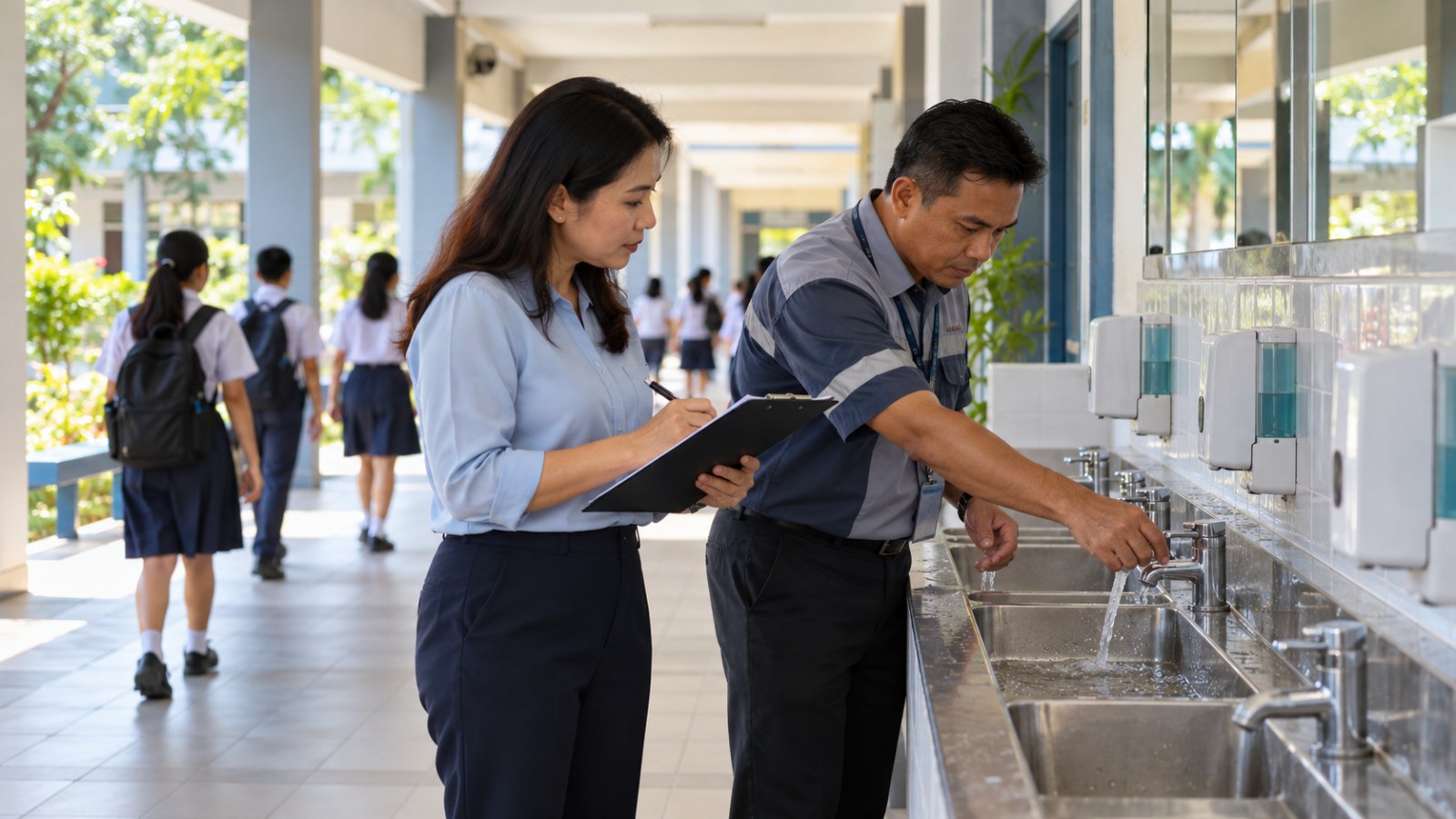
A school opens a newly renovated toilet block. Photographs show clean cubicles, modern sinks and freshly painted walls. The project appears complete, and the facilities are included in the school’s annual improvement report.
Three months later, several taps no longer work. Soap supplies are inconsistent, one accessible toilet is being used for storage, and students complain that certain facilities are frequently locked.
The infrastructure exists. But is it delivering the service students need?
This distinction is central to school water, sanitation and hygiene (WASH) in Asia. For school leaders, constructing facilities is only the beginning. The more demanding responsibility is ensuring that safe drinking water, usable sanitation and effective handwashing remain available throughout the school day.
Meaningful school WASH assessment must therefore examine functionality, accessibility, maintenance and everyday student experience, not simply count completed infrastructure projects.
Why School WASH Is an Education Quality Issue
Water, sanitation and hygiene services are often managed as facilities or public-health responsibilities. Yet their availability also influences the conditions under which children attend school and participate in learning.
Students need drinking water throughout the day. They need toilets that provide privacy, safety and dignity. They also need handwashing facilities that are accessible and supplied with water and soap.
These needs become particularly important for younger children, students with disabilities and students managing menstruation.
UNICEF identifies inadequate water and sanitation as barriers to education across Asia and the Pacific, including through their relationship with absenteeism and unequal access.
The scale of the challenge remains substantial. According to the WHO/UNICEF Joint Monitoring Programme’s 2026 report, worldwide school coverage in 2025 reached 78% for basic drinking-water services, 77% for basic sanitation and 72% for basic hygiene.
These are global estimates rather than figures for every Asian country. Nevertheless, they demonstrate that basic school services cannot be assumed to be universally available.
For education administrators, the practical question is not whether a school has invested in infrastructure. It is whether students can depend on that infrastructure every day.
What Counts as a Basic School WASH Service?
Schools need clear definitions before they can assess performance consistently.
The WHO/UNICEF Joint Monitoring Programme distinguishes between basic, limited and no service for drinking water, sanitation and hygiene.
Drinking Water
A basic drinking-water service requires an improved water source with water available at the school when assessed.
A school may have a piped connection but still experience interruptions. The existence of plumbing alone does not establish that the school meets the basic service definition.
Importantly, the international basic-service indicator does not by itself establish comprehensive drinking-water safety. Where relevant, schools must separately assess water quality against applicable national requirements.
Sanitation
Basic sanitation requires improved toilet facilities that are single-sex and usable.
Usability includes whether facilities are accessible, functional and private. A toilet that is damaged, inaccessible or routinely locked may not provide the service its construction suggests.
Hygiene
Basic hygiene requires handwashing facilities with both water and soap available at the time of assessment.
Installing sinks without maintaining supplies is therefore insufficient.
These internationally recognised definitions provide a useful starting point. Schools must also follow applicable national regulations, building requirements, accessibility provisions and health standards.
The Five-Part School WASH Reliability Framework
School leaders can organise an internal assessment around five connected questions: availability, usability, inclusion, continuity and accountability.
This framework is a practical management approach, not an official accreditation or regulatory standard.
1. Availability: Are Essential Services Present?
The first task is to establish what facilities actually exist and where they are located.
Schools should inventory drinking-water points, toilets, handwashing stations, accessible facilities and relevant hygiene provisions.
The inventory should identify which student groups and buildings each facility serves.
A campus-wide total may conceal important differences. A large secondary school, for example, might have sufficient facilities overall but inadequate provision near a distant classroom block.
2. Usability: Can Students Use the Facilities?
Facilities should be inspected under normal operating conditions, including busy periods.
Questions include:
- Do taps and flushing systems work?
- Are toilets clean, private and appropriately maintained?
- Are water and soap consistently available?
- Are facilities accessible during school hours?
- Are broken fixtures repaired promptly?
- Are drinking-water points functioning when students need them?
Inspections should examine actual functionality rather than relying exclusively on maintenance records or photographs taken after cleaning.
3. Inclusion: Can Every Student Access the Service?
A facility can be operational without being inclusive.
Schools should consider the needs of younger learners, students with mobility limitations, students requiring assistance and those who need adequate privacy for menstrual hygiene management.
Accessible toilets should remain available for their intended purpose. Schools should also review whether pathways, doors, fixtures and arrangements meet applicable accessibility requirements.
Student feedback can identify barriers that routine engineering inspections overlook. Such feedback should be collected respectfully without requiring students to disclose unnecessary personal or medical information.
4. Continuity: Will Services Remain Available?
Water and sanitation infrastructure depends on regular maintenance, consumable supplies and reliable utilities.
Schools should identify how they will respond to water interruptions, blocked toilets, damaged fixtures and supply shortages.
Where flooding, drought or other environmental conditions threaten service continuity, contingency planning becomes particularly important.
For schools in flood-prone parts of Southeast Asia or water-stressed communities, WASH planning should connect with broader school safety and infrastructure management.
5. Accountability: Who Fixes Problems?
Inspections have limited value when nobody is responsible for resolving identified problems.
Every school should establish a clear process for reporting defects, assigning maintenance responsibility, documenting repairs and checking that the service has been restored.
School leadership should receive regular summaries of unresolved problems and repeated failures.
The purpose is not to generate more paperwork. It is to ensure that essential facilities remain dependable.
A Practical School WASH Monitoring Dashboard
School administrators can begin with a small number of indicators rather than building an elaborate reporting system.
| Assessment Area | Suggested Indicator | Evidence Source | Important Limitation |
|---|---|---|---|
| Drinking water | Water points functioning during inspection | Physical inspection and service logs | Functionality does not establish water safety |
| Sanitation | Toilets meeting defined usability criteria | Facility inspection checklist | A single inspection may miss intermittent failures |
| Hygiene | Handwashing stations with water and soap | Unannounced spot checks | Availability does not establish handwashing behaviour |
| Accessibility | Identified access barriers and corrective actions | Accessibility review and feedback | Physical access is only one aspect of inclusion |
| Maintenance | Time taken to resolve reported defects | Maintenance register | Closure records require verification |
| Service continuity | Frequency and duration of service interruptions | Incident and utility records | Reporting quality affects accuracy |
These indicators should be adapted to the school’s size, age groups, infrastructure and local requirements.
For example, the proportion of functioning drinking-water points can be calculated by dividing the number working at inspection by the total number assessed. However, that figure should be accompanied by information about location, capacity and any excluded facilities.
A high percentage does not necessarily mean students have sufficient access at peak times.
Why One Inspection Is Not Enough
School facilities operate under changing conditions.
A toilet may be functional immediately after maintenance but fail repeatedly during the following month. A handwashing station may have soap during a scheduled inspection but remain empty on ordinary afternoons.
Schools therefore need a combination of routine inspections, occasional unannounced checks, maintenance records and appropriately collected student feedback.
These sources serve different purposes.
- Routine inspections establish whether facilities meet defined operating requirements.
- Spot checks help identify inconsistencies that scheduled assessments may overlook.
- Maintenance records reveal recurring defects and the effectiveness of repair processes.
- Student feedback helps identify practical access, privacy and usability concerns.
- Management reviews connect the evidence with budgets, staffing and improvement decisions.
School leaders should look for patterns rather than relying on a single inspection score.
If a particular toilet block repeatedly experiences plumbing problems, replacing individual fixtures may be less effective than investigating the underlying system.
How School WASH Priorities Differ Across Asia
Asia’s education systems operate across very different physical and financial environments.
Urban schools may face pressure from high student density, ageing infrastructure or heavily used shared facilities. Rural and remote schools may face different challenges involving water supply reliability, maintenance access and the availability of replacement parts.
Island and coastal communities may also need to consider extreme weather, flooding and the resilience of water infrastructure.
UNICEF’s regional work highlights the importance of climate-resilient water and sanitation systems, particularly where environmental disruptions affect access to essential services.
These differences mean that schools should not automatically copy another institution’s infrastructure model.
A school in Kuala Lumpur, a rural community in Indonesia and a remote island school in the Philippines may require different operational arrangements even when they are working towards comparable service standards.
The relevant question is whether each school can deliver a safe, reliable and inclusive service under its actual conditions.
From Construction Projects to Sustainable School Improvement
Education infrastructure projects are frequently described through visible outputs: new buildings, renovated toilets, additional sinks or installed water systems.
These outputs matter, but they should be distinguished from ongoing service performance.
Consider a hypothetical school that installs new handwashing stations across several buildings.
The installation report establishes that the equipment was provided. A subsequent functionality review establishes whether water and soap are available. Maintenance records show whether the facilities remain operational. Student feedback may reveal whether their locations and design are practical.
Each form of evidence answers a different question.
For schools planning substantial improvements, a useful project evaluation should include:
- A baseline assessment before construction or renovation.
- Clearly defined service requirements.
- Documentation of completed infrastructure.
- Post-installation functionality checks.
- Maintenance and consumables planning.
- Follow-up assessments after regular use.
- Corrective action where problems remain.
This approach can also strengthen the credibility of institutional improvement reports by separating expenditure, construction and sustained service delivery.
When School Infrastructure Improvements Become Measurable Institutional Achievements
Some education infrastructure initiatives extend well beyond routine campus maintenance.
A coordinated programme may improve facilities across numerous schools, establish a documented regional service milestone or deliver an unusually extensive infrastructure initiative.
Such achievements should be described with precise boundaries and supporting evidence.
Institutions should document what was completed, which facilities were included, when the work occurred, how the results were measured and who verified the information.
Where a milestone is genuinely exceptional and objectively measurable, an education organisation may also explore formal record recognition. Asia Record’s official verification process explains how proposed measurable achievements are assessed and supported by evidence.
However, an infrastructure milestone and an educational outcome are not interchangeable.
Recognition of a measurable installation or participation achievement does not automatically establish drinking-water safety, compliance with sanitation requirements, improved student attendance or superior educational quality.
Those claims require their own evidence and, where applicable, the appropriate regulatory assessment.
Common Mistakes in School WASH Reporting
Counting Toilets Without Checking Usability
A school may report a substantial number of toilets while some remain inaccessible, damaged or unsuitable for students’ needs.
Facility counts should be accompanied by usability assessments and relevant capacity considerations.
Assuming Installed Water Systems Guarantee Safe Water
Water availability and water safety are separate questions.
Schools should follow applicable water-quality requirements and use appropriate testing or authorised assessments where necessary.
Ignoring Recurring Maintenance Problems
Repeated repairs may indicate underlying design, capacity or maintenance weaknesses.
Reporting the number of repairs completed without examining recurring failures can conceal persistent problems.
Overlooking Privacy and Accessibility
Clean facilities are not necessarily appropriate for every learner.
Privacy, disability access, age suitability and menstrual hygiene needs should form part of school infrastructure reviews.
Claiming Educational Impact Without Evidence
Improved WASH services can support better learning conditions. However, schools should not automatically attribute changes in attendance, examination performance or health outcomes to an infrastructure project without a suitable evaluation.
Clear reporting distinguishes the services delivered from the outcomes that have actually been demonstrated.
A School WASH Review Checklist for Principals
School leaders can use the following sequence to organise an initial review.
- Map the facilities. Identify drinking-water points, toilets, handwashing stations and accessible provisions across the campus.
- Check basic functionality. Inspect whether facilities are operational, usable and appropriately supplied.
- Review safety and compliance. Confirm applicable water-quality, sanitation, accessibility and building requirements.
- Identify access barriers. Consider student age, disability, privacy, distance and availability during school hours.
- Examine maintenance records. Identify recurring failures and delays in corrective action.
- Consult students and staff. Gather practical feedback without collecting unnecessary personal information.
- Prioritise urgent problems. Address immediate safety and essential-service failures before cosmetic improvements.
- Assign responsibility. Establish who will investigate, repair and verify each issue.
- Plan for interruptions. Prepare appropriate responses to water shortages, damaged facilities and environmental disruptions.
- Review progress. Reassess services after improvements and report remaining limitations accurately.
The checklist can be implemented using simple inspection forms and maintenance registers. Digital monitoring tools may be helpful for larger institutions, but technology is not a prerequisite for effective management.
Making School WASH Part of Educational Leadership
School WASH should not become visible only when a facility breaks down or a new construction project is announced.
It belongs within ordinary institutional planning, including infrastructure budgets, student inclusion, maintenance oversight and school safety.
Principals and school boards should be able to answer straightforward questions: Are essential services available? Can students use them? Are problems corrected promptly? Are improvements sustained?
Reliable answers require evidence collected during normal school operations, not simply photographs of newly completed facilities.
Across Asia, schools face different infrastructure constraints. Nevertheless, the underlying responsibility is consistent: every student should have practical access to the essential services that support a safe and dignified learning environment.
A school demonstrates progress not merely when it builds a facility, but when that facility continues to serve students as intended.